
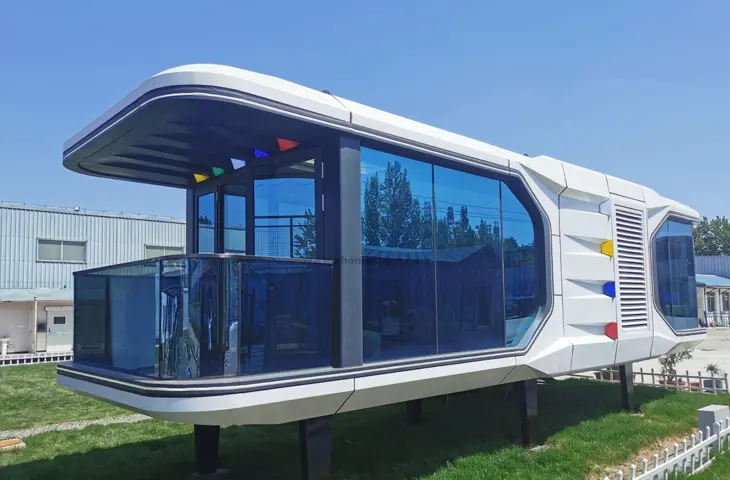
When researching capsule house price, most buyers initially look for one number.
How much does a capsule house cost?
For a private buyer, that may be enough to start a conversation. But for a resort developer, property investor, tourism operator or commercial project owner, the more important question is usually much broader:
What kind of modular building can I create within my project budget?
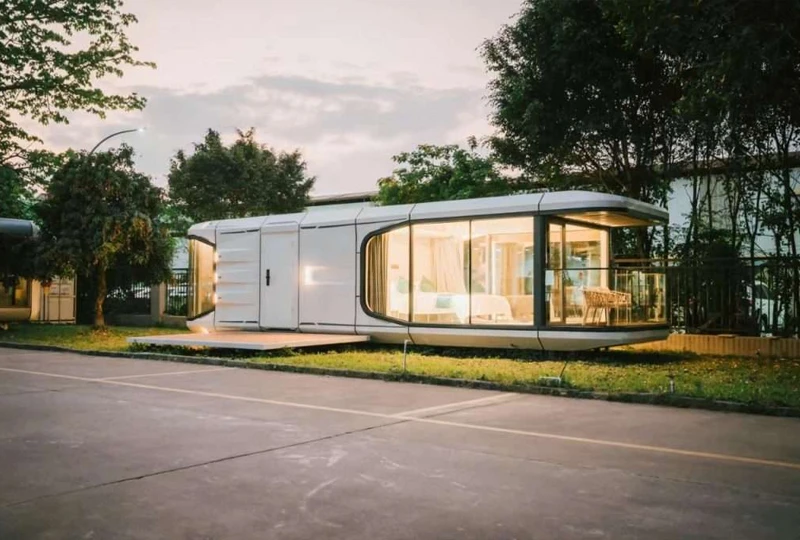
A capsule house may be used as accommodation, but the same factory-based modular construction approach can also create a commercial modular building, modular office, prefab sales office or modular reception building.
This changes how B2B buyers should think about price.
Instead of comparing the factory price of one capsule against another, it is more useful to understand what determines the total project cost and how the same modular manufacturing capability can be adapted to different applications.
At PodVoyager, we manufacture capsule houses and customized modular spaces in Linyi, Shandong, China. Our approach starts with the project’s required space, intended use and site conditions rather than treating every project as a standard product purchase.
Capsule House Price Is Not One Fixed Number
There is no universal capsule house price because capsule houses can have very different specifications.
A small basic unit, a fully furnished accommodation pod and a customized multi-module building are fundamentally different products.
The price can be affected by:
- Building size
- Floor plan
- Structural system
- Exterior materials
- Insulation
- Glazing
- Bathroom configuration
- Kitchen facilities
- Furniture
- HVAC
- Electrical systems
- Smart-home systems
- Interior finishes
- Customization
- Transportation
- Installation requirements
PodVoyager’s existing cost analysis also emphasizes that the factory quotation is only one part of the total investment, with transportation, foundations, installation, utilities and customization potentially affecting the final project budget.
For this reason, asking only for the “cheapest capsule house price” can lead to an incomplete comparison.
A better approach is to compare the complete specification and project scope behind the quotation.
What Does a Capsule House Price Actually Include?
Before comparing suppliers, B2B buyers should ask what is included in the quoted price.
For example, does the quotation cover only the structural shell?
Or does it include a finished accommodation unit?
Depending on the manufacturer, a project may include different levels of completion.
Basic Structure
A basic configuration may focus on:
- Structural frame
- Exterior envelope
- Insulation
- Windows and doors
- Basic electrical preparation
This can work for buyers who plan to complete part of the interior locally.
Finished Accommodation Unit
A resort-grade capsule may include:
- Bedroom
- Bathroom
- Kitchen
- Furniture
- Lighting
- Electrical system
- HVAC
- Interior finishes
This is more suitable for developers who want to deploy the units directly as commercial accommodation.
Customized Modular Building
The scope can become even broader when the project is no longer a single accommodation unit.
A customized modular building may require:
- Multiple modules
- Customized floor plans
- Larger structural systems
- Commercial electrical requirements
- Additional bathrooms
- Office facilities
- Reception areas
- Meeting rooms
- Kitchen or dining areas
- Specialized interior layouts
At this point, the buyer is no longer simply purchasing a capsule house.
They are developing a modular building solution.
The Same Factory Can Produce Different Types of Space
This is an important distinction for B2B buyers.
A modular manufacturer does not necessarily have to be limited to one type of building.
The underlying manufacturing process can be adapted to different purposes.
For example:
Capsule house → accommodation
Modular office → workspace
Prefab sales office → customer-facing commercial space
Modular reception building → hospitality facility
Exhibition module → display or visitor space
The exterior appearance and interior layout may change, but the basic principle remains:
Design → Factory Manufacturing → Transportation → Site Installation
This is where PodVoyager’s positioning goes beyond simply manufacturing glamping pods.
Capsule House Price vs. Commercial Modular Building Cost
Suppose a developer has a project requiring approximately 100–120 m² of usable space.
The project could potentially be approached in several ways.
The developer might construct a conventional building on site.
They might purchase several independent capsule houses.
Or they might develop a multi-module structure designed specifically for the required function.
The right choice depends on the site, application, local requirements and project objectives.
For example, a 120 m² accommodation requirement may be divided into several independent guest units.
But a 120 m² sales office may make more sense as one connected modular building.
The space requirement is similar.
The architecture, module configuration and cost structure are not.
This is why capsule house price should always be considered together with the intended use.
Modular Office: When the Building Is Designed Around Work
A modular office is a good example of how modular construction moves beyond accommodation.
An office needs a different layout from a guest room.
Instead of bedrooms and bathrooms being the main priorities, the project may require:
- Reception
- Open workstations
- Private offices
- Meeting rooms
- Kitchen
- Dining area
- Storage
- Bathrooms
- Outdoor space
The building can then be divided into transportable modules.
The modules are manufactured in the factory and delivered to the project site.
Once positioned, they are connected to form one workplace.
This approach is particularly useful for companies that need a finished office in locations where conventional construction is difficult or time-consuming.
Prefab Sales Office: A Real Commercial Application
A prefab sales office is another example where modular construction can make sense.
Property developers and resort projects sometimes need a professional customer-facing building before a larger development is completed.
The sales office needs to look permanent and professional, while the development itself may still be in progress.
This creates an interesting modular application.
The building can be manufactured in a factory, transported to the project and installed on site.
PodVoyager has already completed a real-world example of this approach in St. Petersburg, Russia.
The project was designed as a 120 m² two-level sales office plus terrace for a seven-person team. Instead of transporting the building as one piece, it was engineered as three factory-finished modules.
The three modules crossed the border separately and were assembled on site as one continuous workplace.
The reported production period was 90 days, with approximately 30 days of transportation and five days of on-site assembly.
This example is particularly useful for understanding what a modular building quotation represents.
The customer was not simply buying three pods.
They were buying a complete commercial space engineered to travel in three parts.
Modular Reception Building for Hospitality Projects
A resort developer also needs spaces that are not guest rooms.
A reception building may need to accommodate:
- Guest check-in
- Waiting areas
- Staff workspace
- Storage
- Bathrooms
- Guest information
- Management functions
A standard accommodation capsule may not be the best solution for this application.
Instead, the manufacturer can develop a modular reception building around the actual operational requirements.
The structure can be larger than a standard capsule and can use several modules to create a connected interior.
This is another reason why B2B buyers should not think about modular construction only in terms of individual pods.
The better question is:
What space does the project need?
Why Site Conditions Affect Capsule House Price
The same capsule house can have different project costs depending on where it will be installed.
A flat site with easy truck access is different from a remote mountain location.
A warm climate has different requirements from a cold northern climate.
A coastal project may require different material considerations from an inland site.
Site conditions can affect:
- Foundation requirements
- Transportation
- Crane access
- Installation
- Insulation
- HVAC
- Plumbing
- Electrical systems
- Weather protection
- Local compliance
For example, PodVoyager’s St. Petersburg sales office required specific winter-performance considerations, including a continuous thermal envelope, 150 mm sprayed polyurethane insulation, triple-pane insulated glazing and freeze-protection systems.
Those specifications are project-specific.
They should not simply be added to every building or ignored when comparing quotations.
Transportation Is Part of the Price
International buyers sometimes focus heavily on the factory price and only later consider transportation.
For modular buildings, this can be a mistake.
A finished building needs to travel from the factory to the destination.
That may involve:
Factory loading → inland transportation → port → international shipping → destination port → local transportation → site → crane installation
The dimensions and weight of each module can affect transportation planning.
This is why module design should happen before manufacturing.
A building that is easy to use but difficult to transport may not be an efficient international solution.
The St. Petersburg project provides a good example.
The completed building was 120 m², but it was divided into three transportable modules specifically because the final building was too large to move as one completed structure.
The Cheapest Capsule House May Not Be the Cheapest Project
This is one of the most important points for B2B buyers.
Imagine two suppliers.
Supplier A offers a lower factory price.
Supplier B offers a higher factory price but includes more complete interior finishing, better insulation, more integrated systems and a clearer installation plan.
The lower factory quotation does not automatically mean the lower total project cost.
The buyer may later need to pay for:
- Additional interior work
- Local contractors
- Electrical modifications
- Plumbing
- Insulation upgrades
- Installation
- Additional transportation
- Equipment
- Site labor
Therefore, the correct comparison is not:
Supplier A price vs. Supplier B price
It is:
Supplier A total project scope vs. Supplier B total project scope
This is particularly important for international B2B projects.
Capsule House Price Should Be Compared by Specification
When requesting quotations from Chinese manufacturers, prepare the same specification for every supplier.
For example:
Area: 40 m²
Application: Glamping accommodation
Bedrooms: 2
Bathroom: 1
Kitchen: Included
HVAC: Included
Furniture: Included
Glazing: Double or triple glazing
Smart system: Required
Destination: Country and city
Quantity: 10 units
Installation: Required or not required
This allows suppliers to quote against the same requirements.
Without a clear specification, one manufacturer may quote a basic shell while another quotes a fully finished accommodation unit.
The two prices cannot be meaningfully compared.
What If You Need More Than a Capsule House?
This is where the concept of customized modular space becomes particularly useful.
Maybe your project does not actually need ten identical capsule houses.
Maybe you need:
- 8 guest units
- 1 reception
- 1 office
- 1 service building
Instead of treating these as completely separate construction projects, you can approach them as one modular development.
The accommodation units can use one configuration.
The reception can use another.
The office can be designed around staff requirements.
The service space can be configured around its operational function.
The same manufacturer can coordinate the overall modular approach.
From Capsule House Price to Project Cost
For B2B buyers, the ultimate question should move from:
“How much is one capsule house?”
to:
“What will it cost to create the space my project actually needs?”
That distinction is important.
A capsule house may be the right answer for one requirement.
A modular office may be better for another.
A prefab sales office may be appropriate for a property development.
A modular reception building may make more sense for a resort.
Several modules may be combined into a larger commercial building.
The price depends on what you are actually trying to build.
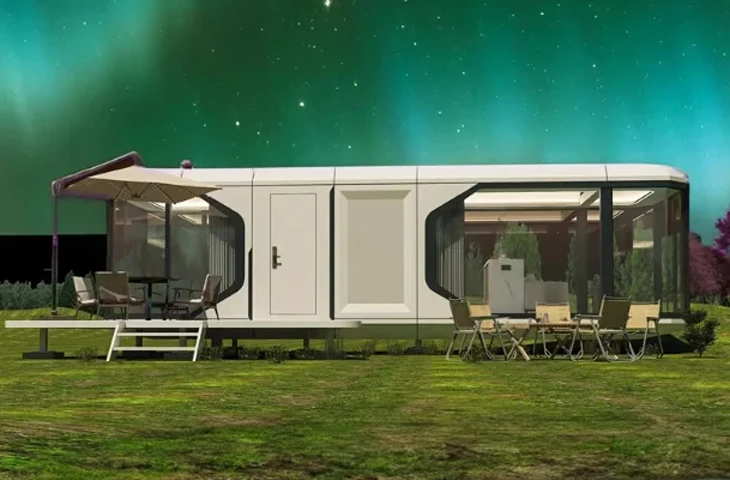
PodVoyager: From Capsule Houses to Commercial Modular Buildings
PodVoyager is based in Linyi, Shandong, China, and manufactures capsule houses and customized modular spaces for international projects.
The company’s product range includes capsule houses for glamping and hospitality, but its manufacturing approach can also be used for larger commercial applications.
The St. Petersburg project is a clear example.
Three factory-finished modules were manufactured and transported separately, then assembled into one 120 m² two-level sales office with a terrace. The finished building was designed for a seven-person team and included reception, open office space, meeting facilities, bathroom, kitchen and dining areas.
This demonstrates an important capability:
The final building does not have to look or function like a capsule house simply because it was manufactured using modular construction.
The same production philosophy can create different spaces for different purposes.
How PodVoyager Approaches a New Project
When a B2B customer contacts PodVoyager, the most useful information is not necessarily a preferred product model.
Start with:
Required area
How many square meters do you need?
Purpose
Is the space for accommodation, office work, sales, reception, exhibition or another function?
Site
Where will it be installed?
Climate
What environmental conditions will the building need to handle?
Quantity
Is this one building or a multi-unit development?
Timeline
When does the project need to be operational?
Transportation
Are there access or transportation limitations at the destination?
From these details, the modular configuration can be developed.
This is often a better starting point than simply asking for a standard capsule house price.
A Capsule House Is One Possible Modular Space
The term “capsule house” describes a product category.
But modular construction is a much broader concept.
A single module can become accommodation.
Several modules can become a commercial office.
A customized structure can become a sales center.
A connected modular system can become a reception building.
The key is not the shape of the pod.
The key is the ability to design and manufacture the space around its intended purpose.
That is why PodVoyager’s approach extends from capsule houses to commercial modular buildings.
Final Thoughts on Capsule House Price
If you are researching capsule house price, do not stop at the factory quotation.
First define what you actually need.
Do you need a guest room?
A group of resort units?
A modular office?
A prefab sales office?
A modular reception building?
Or a completely customized commercial space?
Once the purpose is clear, the required area, layout, materials, systems, transportation and installation can be evaluated together.
For international B2B buyers, this creates a more realistic understanding of project cost.
Give us your space requirement, intended use and site conditions, and we can work backward toward a modular solution that can be manufactured, transported, installed and used.
At PodVoyager, we do not believe every project needs to start with a standard capsule house.
From a single capsule house to a multi-module commercial building, the starting point is the same:
Your space. Your purpose. Your site.
Explore PodVoyager’s modular building solutions or discuss your project with our team.
