
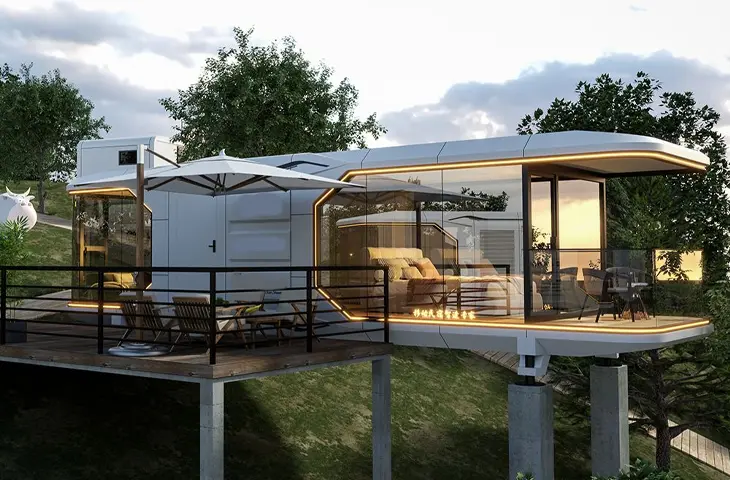
The hospitality industry is changing rapidly. Resort investors are no longer limited to traditional hotel construction when developing new tourism projects.
Today, many developers are exploring prefab capsule houses as an alternative accommodation solution because they offer faster construction, flexible design, and lower project complexity.
However, an important question remains:
Are prefab capsule houses really a better investment than traditional hotels?
The answer depends on project goals, location, budget, and business strategy.
At PodVoyager, we design and manufacture customized capsule houses and modular accommodation solutions in Linyi, Shandong, China, helping global investors create modern hospitality projects with flexible development models.
This article compares prefab capsule houses and traditional hotels from the perspective of investment, construction, operation, and long-term value.
Traditional Hotels: Advantages and Challenges
Traditional hotels have been the standard accommodation model for decades.
They offer:
- Established operating models
- Large guest capacity
- Professional hospitality infrastructure
- Strong brand recognition opportunities
However, traditional hotel construction also comes with significant challenges.
Long Construction Period
A traditional hotel requires:
- Architectural design
- Building approval
- Foundation construction
- Structural work
- Interior decoration
- Equipment installation
The entire process may take months or even years before opening.
For investors, this means:
- Longer capital recovery cycles
- Higher financial pressure
- Delayed revenue generation
High Initial Investment
Traditional hotels usually require substantial investment in:
- Land development
- Construction materials
- Labor costs
- Engineering management
- Interior decoration
Large upfront investment increases project risk, especially for first-time tourism investors.
Limited Flexibility After Completion
Once a traditional hotel is completed:
- Room layouts are difficult to change
- Expansion requires new construction
- Relocation is almost impossible
This creates limitations when market demand changes.
What Are Prefab Capsule Houses?
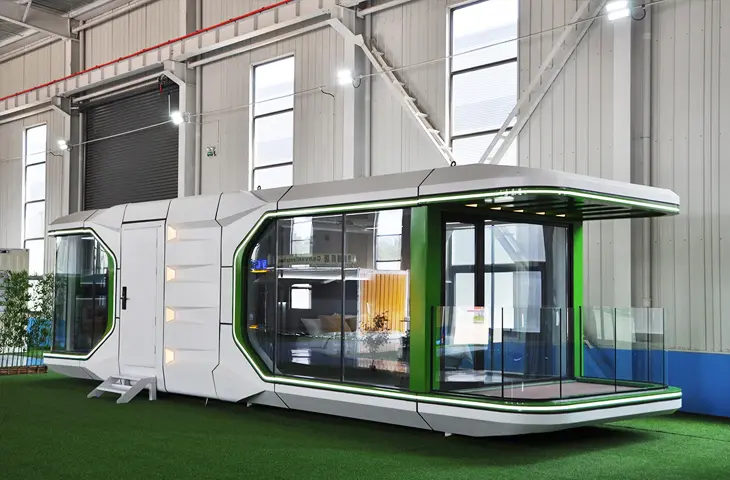
Prefab capsule houses are modular accommodation units manufactured in factories and installed on-site.
They combine:
- Modern architectural design
- Efficient manufacturing
- Flexible deployment
- Hospitality-level comfort
They are widely used in:
- Glamping resorts
- Eco-tourism projects
- Scenic areas
- Boutique accommodation developments
- Private retreats
Why Prefab Capsule Houses Are Becoming Popular
Faster Construction and Installation
One of the biggest advantages of prefab capsule houses is speed.
Because most production happens in a factory:
- Manufacturing time is controlled
- On-site construction is minimized
- Installation is faster
This allows investors to launch accommodation projects much earlier.
Earlier opening means:
- Earlier bookings
- Faster revenue generation
- Shorter investment recovery period
Lower Project Complexity
Compared with traditional hotels, capsule house projects usually involve:
- Less on-site construction
- Fewer labor requirements
- More predictable production processes
This makes them especially suitable for:
- Remote tourism locations
- Mountain areas
- Forest resorts
- Coastal destinations
Flexible Expansion Capability
One of the biggest differences between traditional hotels and modular accommodation is scalability.
A traditional hotel requires large initial construction.
Prefab capsule houses allow investors to:
- Start with several units
- Test market demand
- Expand gradually
For example:
A resort can begin with 10 capsule houses and later expand to 30 or 50 units without rebuilding the entire project.
Cost Comparison: Prefab Capsule Houses vs Traditional Hotels
The total investment depends on project scale, but the difference is clear.
Traditional Hotel Investment Includes:
- Large-scale construction
- Structural engineering
- Interior decoration
- Long construction management
- Higher labor costs
Prefab Capsule House Investment Includes:
- Modular unit purchase
- Foundation preparation
- Transportation
- Installation
- Utility connection
The biggest advantage is not simply lower cost.
The real advantage is:
More predictable investment and faster return potential.
Guest Experience Comparison
Some investors believe traditional hotels automatically provide better experiences.
However, modern travelers increasingly value uniqueness.
Traditional Hotel Experience
Advantages:
- Standardized service
- Familiar environment
- Larger facilities
Limitations:
- Less unique
- Similar experience across destinations
Capsule House Resort Experience
Advantages:
- Immersive natural environment
- Unique architecture
- Panoramic views
- Private outdoor spaces
Modern travelers often choose destinations based on:
- Experience
- Design
- Social media appeal
- Connection with nature
This gives capsule house resorts strong market differentiation.
Environmental Impact Comparison
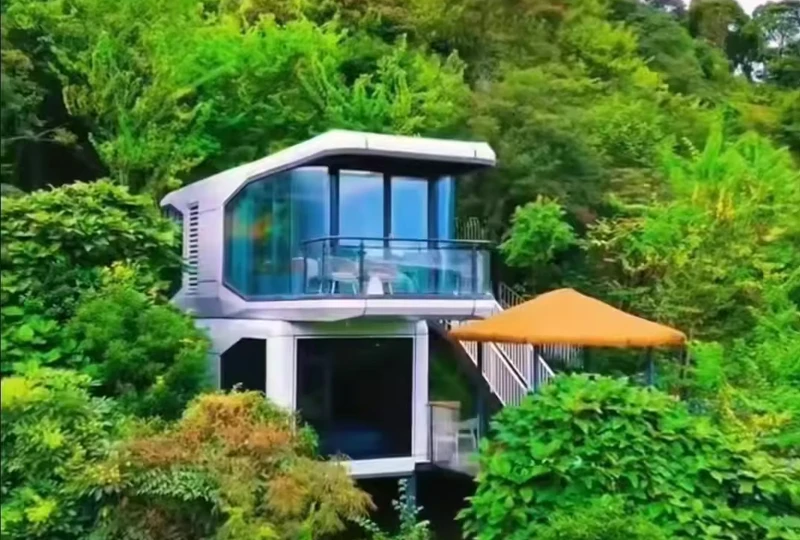
Sustainability has become an important factor in tourism development.
Traditional construction often involves:
- More construction waste
- Larger land disturbance
- Longer building processes
Prefab capsule houses offer:
- Factory-controlled material usage
- Reduced construction waste
- Minimal site disruption
- Potential relocation capability
This makes them suitable for eco-tourism projects.
Which Investment Model Is Better?
The answer depends on your business goal.
Traditional Hotels Are Better For:
- Large urban developments
- High-density accommodation
- Established hotel brands
- Long-term permanent buildings
Prefab Capsule Houses Are Better For:
- Nature tourism projects
- Glamping resorts
- Scenic destinations
- Remote locations
- Fast-launch accommodation businesses
Why Many Investors Choose a Hybrid Approach
The future of hospitality may not be either traditional hotels or modular accommodation.
Many successful projects combine both.
For example:
- Traditional main building
- Modular guest rooms
- Prefab reception lobby
- Outdoor experience spaces
This creates a flexible hospitality ecosystem.
At PodVoyager, we provide modular solutions that can work independently or integrate with larger tourism developments.
Why Choose PodVoyager for Prefab Capsule House Projects
Based in Linyi, Shandong, China, PodVoyager specializes in capsule houses, glamping pods, and modular space solutions.
We support global clients with:
- Custom architectural design
- Factory manufacturing
- Quality-controlled production
- International shipping
- Project planning support
Our mission is to help investors build unique and profitable hospitality spaces with modern modular solutions.
Conclusion
Prefab capsule houses are not simply a cheaper replacement for traditional hotels.
They represent a different approach to hospitality development:
- Faster construction
- Greater flexibility
- Lower project complexity
- Stronger design differentiation
For investors developing resorts, eco-tourism destinations, and boutique accommodation projects, prefab capsule houses provide a practical alternative with significant commercial potential.
The best solution depends on your project goals, but for flexible and experience-driven tourism development, modular accommodation is becoming an increasingly attractive choice.
Explore more at https://podvoyager.com/ and discover how PodVoyager can support your next resort project.
