
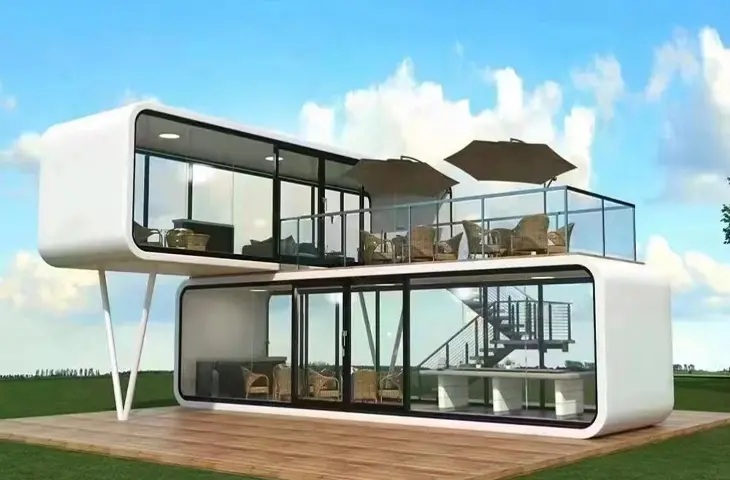
When people search for 中國風豪華露營艙, they often have one idea in mind: a prefabricated pod that can be placed on a scenic site and used as a guest room.
That is certainly one of the most common applications.
But it is not the limit of what a modular pod manufacturer can provide.
For a developer, investor, resort operator, or property owner, the real question is often not:
“Which capsule house should I buy?”
It is:
“I have this site, this amount of available space, and this purpose. What kind of building can be manufactured, transported, installed, and put into operation here?”
This changes the way modular buildings should be approached.
A capsule house can be a starting point. But with the right design and manufacturing process, the same modular thinking can be applied to accommodation, offices, reception buildings, sales offices, service facilities, exhibition spaces, and other commercial environments.
在 PodVoyager, we manufacture customized capsule houses and modular spaces in Linyi, Shandong, China. Our approach is not simply to provide a selection of finished pod models. We work from the project requirement: space size + intended use + site conditions, and then develop a modular solution that can be manufactured and delivered to the project.
Chinese Glamping Pods: Start With the Project, Not the Product
A traditional product-based approach starts with a catalog.
A buyer chooses a model, checks the dimensions, selects a configuration, and places an order.
That works when the buyer already knows exactly what they need.
But many international projects are not that simple.
A developer may have:
- A piece of land near a lake
- A 500㎡ area within an existing resort
- A requirement for a small reception building
- An unused section of a campground
- A need for a temporary or permanent sales office
- A scenic site where conventional construction is difficult
- A requirement for several different functional spaces
In these situations, the starting point should not necessarily be a specific capsule house.
The starting point should be the space requirement.
How much area is available?
What will the space be used for?
How many people will use it?
What facilities need to be included?
What are the transportation limitations?
What is the local climate?
How will the modules be positioned on site?
Once these questions are understood, the manufacturer can work backward toward a suitable modular structure.
This is the difference between simply buying a prefab product and developing a custom modular space solution.
From Capsule House to Modular Space
The word “pod” can sometimes make a building sound smaller or more limited than it really is.
A modern modular structure does not have to be restricted to a single room.
It can be designed as an individual unit or as multiple modules working together.
One module might function as a guest room.
Several modules can be connected to create a larger building.
Different modules can serve different functions within the same project.
The result is a modular system rather than a single standardized product.
For example, a resort might use one configuration for accommodation, another for reception, and another for staff or service facilities.
A commercial property might need a reception area, offices and meeting rooms.
A tourism project could require a visitor center, ticketing area, retail space and guest accommodation.
The physical form changes according to the purpose.
The modular manufacturing principle remains the same.
What Can Chinese Glamping Pods Become?
該術語 中國風豪華露營艙 is strongly associated with tourism accommodation, and that remains an important application.
But customized modular structures can serve a much wider range of purposes.
Guest Accommodation
This remains one of the most natural applications.
A modular capsule can be configured as a self-contained guest unit with sleeping areas, bathroom facilities, kitchen equipment, climate control and other interior systems.
For glamping resorts, this makes it possible to develop accommodation capacity without relying entirely on conventional on-site construction.
PodVoyager’s current capsule house range includes different configurations designed around outdoor hospitality and resort applications.
But accommodation is only one category.
Reception and Welcome Buildings
A resort needs more than bedrooms.
Guests may need a place to check in, receive information, meet staff, purchase services or wait for transportation.
A modular structure can be designed specifically as a reception building rather than adapting a guest room for that purpose.
The layout can include a reception counter, waiting area, office, storage, bathroom or other functions required by the operator.
Sales Offices
A sales office is another strong application for modular construction.
Property developers, resort projects and new commercial developments may need a customer-facing building before the permanent development is completed.
Instead of constructing a conventional building from scratch, a modular sales office can be manufactured in a factory and delivered to the project.
PodVoyager has already applied this concept in a real project in St. Petersburg, Russia.
Three factory-finished modules were transported separately and assembled into a 120㎡ two-level sales office with a terrace. The completed building included reception, open office space, a meeting room, bathroom, kitchen and dining area. The on-site assembly was completed in five days.
This is a useful example of what “modular space” means in practice.
The modules were not simply three independent pods.
They were designed to become one complete workplace.

Offices and Workspaces
A modular building can also become a permanent or semi-permanent workplace.
The requirements are different from accommodation.
An office may need:
- Open workstations
- Private offices
- Meeting rooms
- 接待處
- Kitchen or break area
- Storage
- Restrooms
- Network and electrical infrastructure
These requirements can be considered during the design stage rather than being added after the modules arrive at the site.
The St. Petersburg project demonstrates this principle clearly: the building was divided into transportable modules, but the final design was developed as one connected workplace.
Service Spaces
Tourism projects often need small buildings that are essential to operation but are not accommodation.
Examples include:
- Visitor service centers
- Staff facilities
- Changing rooms
- Rest areas
- Site management offices
- Security facilities
- Maintenance spaces
- Public service buildings
These spaces may have relatively simple functions, but their location and construction requirements can make traditional building methods inefficient.
A customized modular structure can be designed around the actual operational requirement.
Exhibition and Display Spaces
Modular architecture can also be used for exhibitions, product displays and brand experiences.
A manufacturer, property developer or tourism operator may need a physical space to present:
- Real estate projects
- New products
- Local tourism resources
- Construction concepts
- Hospitality developments
- Brand information
Instead of treating the building as a generic container, the structure can be designed around the visitor experience.
The exterior becomes part of the presentation.
The interior becomes part of the brand environment.
And because the building is modular, it can potentially be adapted or relocated as the project develops.
The Same Principle: Space + Purpose + Site
This is the core of customized modular manufacturing.
A successful solution should start with three basic inputs:
Space
How much area do you need?
A 20㎡ unit, a 40㎡ accommodation space, a 120㎡ office, or a larger multi-module building will require completely different structural and transportation planning.
Purpose
What will the building actually do?
Sleeping, working, receiving guests, selling property, providing services, displaying products or operating as a commercial facility all create different layout requirements.
Site
Where will it be installed?
A lakeside resort, mountain destination, urban development, coastal property and remote tourism site can have very different requirements for transportation, access, climate protection, foundation, utilities and installation.
These three factors should be considered together.
That is why a professional modular manufacturer should not only ask:
“Which model do you want?”
A better starting question is:
“What are you trying to build?”
Designing the Building Around Transportation
One of the most important differences between modular construction and conventional construction is that the building has to exist in two conditions.
First, it has to work as a complete building.
Second, it has to be possible to manufacture, transport and assemble.
This means transportation should be considered during the design stage.
The dimensions of each module can affect:
- 工廠生產
- Loading
- Road transportation
- Port handling
- Site access
- Crane requirements
- Final assembly
The St. Petersburg sales office provides a good example.
The final building was 120㎡, but it was too large to transport as one completed structure. Instead, the design was divided into three independent transport modules and engineered to come together as one building on site.
This is an important principle for international modular projects:
The final building and the transport modules do not have to be the same thing.
The building can be designed for how people will use it, while the module structure is engineered around how it needs to travel.
Factory Manufacturing Is Only One Part of the Solution
Saying that a building is “prefabricated” is not enough.
For an international project, the manufacturer needs to think about the entire process.
The project may involve:
Design → Engineering → Factory Manufacturing → Packaging → Transportation → Site Positioning → Connection → Installation → Final Use
If one stage is ignored, problems can appear later.
For example, a beautiful design may be difficult to transport.
A transportable module may not provide the desired interior layout.
A building that works in the factory may require excessive on-site work.
A product designed for one climate may require different insulation, HVAC or freeze-protection considerations in another location.
This is why customized modular manufacturing is fundamentally a project-oriented process.
Chinese Manufacturing Gives Buyers More Than a Finished Pod
China is widely known for its manufacturing capabilities, and Chinese glamping pods have become one part of the broader international modular building market.
But for B2B buyers, the value of working with a Chinese manufacturer should not be reduced to product price.
The more important question is whether the factory can translate a project requirement into a manufacturable product.
That means understanding:
- 結構要求
- 材料選用
- 內裝配置
- 電氣與給排水系統
- Climate requirements
- 交通限制
- Module connections
- Installation procedures
- Project quantity
- Customization requirements
PodVoyager’s current positioning covers both customized capsule housing and broader modular space solutions for tourism and commercial projects.
This allows the conversation to move beyond “Which pod do you sell?” toward a more useful question:
“What space are you trying to create?”
One Manufacturer, Different Spaces
Consider a hypothetical glamping resort development.
The developer may need:
- 10 guest accommodation units
- 1 reception building
- 1 restaurant or lounge
- 1 staff office
- 1 service building
These do not necessarily need to be five completely unrelated construction projects.
They can be considered as part of one modular development strategy.
The accommodation units can use one configuration.
The reception can use another.
The office can be designed around staff workflow.
The service building can be configured around equipment and operational needs.
The architecture can still maintain a consistent visual language across the site.
This is where modular construction becomes more interesting than simply purchasing a prefab cabin.
The goal is not to manufacture the same box repeatedly.
The goal is to manufacture different spaces using a coordinated modular system.
From a Glamping Pod Supplier to a Modular Space Partner
For a buyer searching for Chinese glamping pods, the supplier’s product catalog is useful.
But for a larger project, the manufacturer’s capability matters more.
Can they understand a floor plan?
Can they modify the interior?
Can they combine modules?
Can they work around transportation restrictions?
Can they design different functions?
Can they coordinate structural, interior and MEP requirements?
Can they manufacture the result consistently?
These questions become increasingly important as the project becomes larger or more customized.
PodVoyager’s approach is therefore not limited to offering standard capsule houses.
The company manufactures customized modular spaces in Linyi, Shandong, China, and its project portfolio already includes applications beyond accommodation, including the multi-module sales office in Russia.
Your Project Does Not Have to Start With a Pod Model
This may be the most important idea for international buyers.
You do not necessarily need to begin with:
“I want a V8.”
You can begin with:
“I need a 60㎡ reception and office building.”
Or:
“I have a lakeside site and need 20 accommodation units.”
Or:
“I need a two-level commercial space that can be transported in separate modules.”
Or:
“I need a small visitor center that can be installed with limited on-site construction.”
From there, the manufacturer can work backward from the requirement.
The model is not the starting point.
The project is the starting point.
Chinese Glamping Pods, Reimagined as a Modular Building System
Chinese glamping pods have become popular because they provide a different way to create accommodation in outdoor and tourism environments.
But the underlying technology and manufacturing capability can go much further.
A capsule house can become a guest room.
Several modules can become an office.
A customized layout can become a reception building.
A multi-module structure can become a sales office.
A purpose-designed space can become a service facility or exhibition building.
The common factor is not the shape of the building.
It is the ability to transform a project requirement into a manufacturable, transportable, installable and usable modular space.
That is the direction PodVoyager is taking.
We do not only manufacture capsule houses.
We work with the relationship between space, purpose and site conditions to develop modular buildings for real-world applications.
From Capsule House to Commercial Space
If you are searching for 中國風豪華露營艙, you may already have a specific accommodation project in mind.
But if your requirement is larger than a guest room, the same conversation can start from a different point.
Tell us:
How much space do you need?
What will you use it for?
Where will it be installed?
From a glamping accommodation unit to a sales office, from a reception building to a commercial workspace, PodVoyager can develop the modular structure around your project requirements.
The objective is not simply to sell you a pod.
It is to turn your available site and intended use into a modular space that can be manufactured, transported, installed and put into operation.
Explore PodVoyager for Chinese glamping pods, capsule houses and customized modular space solutions, or contact the team to discuss your project requirements.
