
Finding the right accommodation solution for a commercial or tourism project is not always straightforward. Traditional construction may require extensive on-site work, while standard buildings may not fit the project’s location, layout, intended use, or development budget.
Modular accommodation units offer an alternative by combining factory-based manufacturing with project-specific planning. These units can be designed for different accommodation needs, transported to the destination, and integrated into a site according to the project’s requirements.
For resort developers, tourism operators, commercial property owners, and international buyers, modular accommodation units provide an opportunity to rethink how guest rooms, independent living spaces, and temporary accommodation are developed.
At PodVoyager, modular accommodation is not limited to a single building type. Different capsule house designs and module combinations can be considered according to the project location, available space, intended application, and functional requirements.
What Are Modular Accommodation Units?
Modular accommodation units are prefabricated spaces designed to provide accommodation functions through factory-produced or factory-assembled building modules. Depending on their configuration, they may include sleeping areas, bathrooms, furniture, electrical systems, windows, insulation, and other essential interior facilities.
Unlike conventional construction, where most building work takes place on-site, modular accommodation units are produced using a manufacturing process before being transported to the destination. Site preparation, foundations, utility connections, lifting, and installation may still be required, depending on the unit design and project conditions.
Modular accommodation does not necessarily mean small, basic, or temporary. Units can be designed for different purposes, from compact independent guest rooms to larger multi-module accommodation spaces.
For commercial buyers, the main advantage is the ability to evaluate accommodation as a configurable product rather than starting every project with an entirely new construction process.
Where Can Modular Accommodation Units Be Used?
The application of modular accommodation units depends on the project requirements. Different industries may use similar modular structures but require very different layouts, equipment, and operating conditions.
Tourism and Resort Accommodation
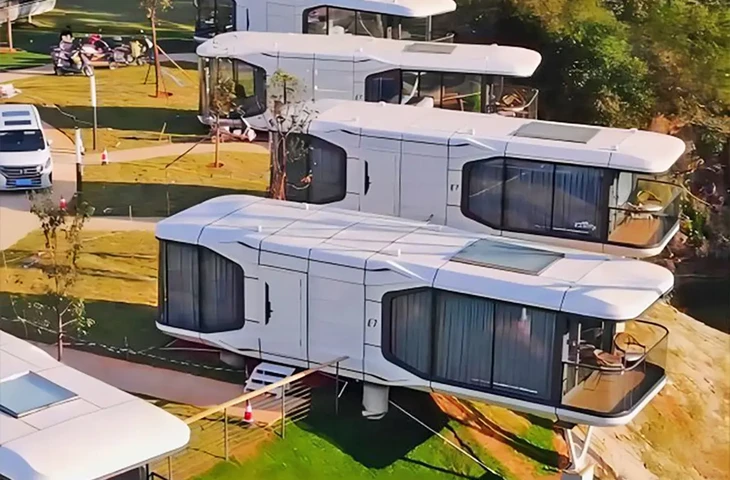
Tourism developments are among the most relevant applications of modular accommodation. Resorts, nature retreats, glamping destinations, and scenic-area accommodation projects often need independent guest rooms that can be integrated into their surroundings.
Modular units can help developers create accommodation clusters, establish private guest spaces, or introduce new room inventory in stages. Depending on the selected design, a unit may feature large windows, private bathrooms, integrated furniture, and an interior layout suited to short-term hospitality use.
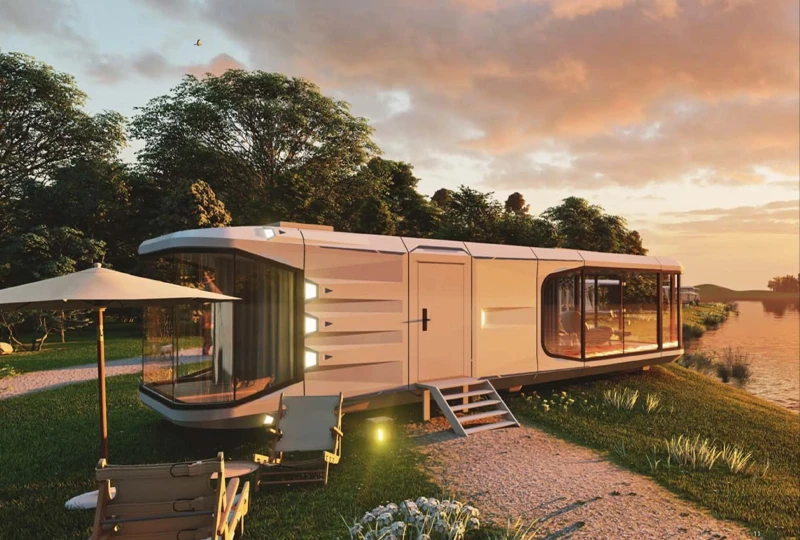
For nature-based resorts, the accommodation itself can become part of the guest experience. The relationship between the room, the landscape, privacy, and outdoor space may be just as important as the interior layout.
PodVoyager 的 Glamp V8 is one example of modular capsule accommodation that developers can evaluate for resort and tourism projects.
Commercial and Business Projects
Some commercial projects require more than conventional offices or permanent buildings. Modular accommodation units may be considered for staff spaces, project-related accommodation, visitor facilities, or other functions where an independent indoor space is required.
The design requirements depend on the actual application. A unit used for personnel accommodation may need practical sleeping arrangements and durable interior finishes, while a visitor-oriented space may place more emphasis on appearance, comfort, and layout.
Before selecting a modular unit, buyers should identify its primary function and the equipment required to support daily use.
Remote and Site-Based Accommodation
Projects located away from established urban infrastructure may face challenges related to conventional construction, access, materials, labor, and site conditions.
Modular accommodation units can provide another option for projects that require independent accommodation in locations where construction logistics need to be carefully managed.
However, remote deployment still requires planning for transportation access, unloading, lifting, foundations, electricity, water, wastewater treatment, and maintenance. The feasibility of using modular units depends on the actual site and the product’s technical requirements.
Seasonal and Phased Accommodation Projects
Some tourism and commercial developments operate according to seasonal demand or a phased investment plan. Instead of developing all accommodation capacity at once, project owners may explore an initial phase followed by additional units when the project progresses.
Modular accommodation can potentially support this approach when the site layout, infrastructure, product configuration, and approvals allow future expansion.
The key is to consider future unit placement and utility capacity during the initial planning stage rather than treating expansion as an entirely separate project.
Why Choose Modular Accommodation Instead of Traditional Construction?
Modular accommodation is not a universal replacement for traditional construction. However, it can be an attractive option for projects where repeatable unit design, factory production, and site coordination are important.
Factory-Based Manufacturing
Manufacturing accommodation units in a controlled environment allows production to follow a defined process. Depending on the manufacturer and product, structural components, interior finishes, electrical provisions, furniture, and other elements may be coordinated before the unit is delivered.
This can help buyers understand what is included in the product and review specifications before shipment.
Factory production does not eliminate the need for quality inspection. Buyers should still review materials, production procedures, finished-unit checks, and the documentation available for the specific product.
More Flexible Project Planning
Modular accommodation units can provide more flexibility in how a development is planned. Developers may consider different room configurations, unit arrangements, or combinations of modules depending on available space and intended use.
This is particularly relevant when the project needs independent accommodation rather than one large building with a conventional corridor-based layout.
The degree of flexibility depends on the modular system. Some products are based on fixed dimensions and standard layouts, while others allow a wider range of customization.
A Different Approach to Site Development
With modular accommodation, some manufacturing work takes place away from the project site. This may help developers coordinate production with site preparation and infrastructure work.
The actual schedule still depends on manufacturing lead time, transportation, site access, foundations, lifting arrangements, utility connections, local inspections, and installation requirements.
The benefit should be evaluated based on the complete project timeline rather than the factory production period alone.
Accommodation That Fits the Project Concept
Modular accommodation units can take different forms and appearances. Developers do not necessarily need to use conventional cabin-style buildings when planning independent accommodation.
Capsule-style units, contemporary modular rooms, multi-module structures, and distinctive hospitality accommodation may all be considered depending on the manufacturer’s available product range.
For projects that depend on visual identity, the accommodation design can contribute to the overall positioning of the development.

How to Choose the Right Modular Accommodation Unit
The best modular accommodation unit is the one that meets the project’s functional, spatial, environmental, and operational requirements. Buyers should evaluate the product from several perspectives before requesting a final quotation.
1. Define the Intended Use
Begin with the purpose of the unit. Is it designed for resort guests, tourism accommodation, workers, commercial use, or a specialized project?
The intended use affects room layout, occupancy, furniture, bathroom facilities, interior finishes, climate-control requirements, and durability expectations.
A hospitality unit should be evaluated around the guest experience, while a practical accommodation unit may prioritize functionality, maintenance, and efficient use of space.
2. Evaluate Dimensions and Space Requirements
Product dimensions influence how units can be arranged on a site, how many accommodation spaces can be developed, and how transportation and installation will be managed.
Buyers should review both external dimensions and internal usable space. The size of the room, furniture arrangement, bathroom layout, circulation space, and window positioning all affect how comfortable and functional the accommodation will be.
If the project has limited land, it is important to balance unit quantity with privacy, outdoor space, access, and the overall layout.
3. Review Materials and Climate Performance
Modular accommodation units may be used in a wide range of climates and environments. Buyers should verify that the selected product’s materials and technical specifications are appropriate for the intended destination.
重要考量事項包括:
- Structural materials and construction details
- Insulation and thermal performance
- Waterproofing and drainage
- Window and door specifications
- Ventilation and air-conditioning provisions
- Corrosion resistance where relevant
- Interior materials and maintenance requirements
For coastal locations, humid environments, cold regions, or areas with high temperatures, the manufacturer should provide relevant technical information rather than relying on general product descriptions.
4. Check Facilities and Equipment
Accommodation requirements vary by project. Some units may need only a sleeping area and basic electrical facilities, while others require private bathrooms, showers, furniture, lighting, air conditioning, and additional equipment.
Before purchasing, prepare a list of required facilities and confirm which items are included in the standard product specification.
This helps prevent unexpected costs caused by assuming that every modular accommodation unit comes fully equipped.
5. Consider Transportation and Site Installation
A modular unit needs to reach the site and be installed under suitable conditions.
Buyers should consider access roads, transport dimensions, unloading space, crane or lifting requirements, foundations, drainage, utility connections, and installation responsibilities.
International projects may also require export packaging, ocean freight, customs clearance, destination transportation, and local contractors.
A product that fits the accommodation requirements may still be unsuitable if it cannot be delivered or installed efficiently at the destination.
Modular Accommodation Units vs. Prefabricated Cabins
Modular accommodation units and prefabricated cabins are closely related terms, but they do not always refer to the same type of product.
Prefabricated cabins often describe cabin-style structures manufactured in advance and delivered to the site. Modular accommodation units are a broader category that can include different building forms, room configurations, capsule-style units, and combinations of modules.
| Comparison | Modular Accommodation Units | Prefabricated Cabins |
|---|---|---|
| Product form | Different modular building and accommodation configurations | Often cabin-style structures |
| Design flexibility | Depends on modular system and configuration | Depends on cabin design and manufacturer |
| Applications | Tourism, resorts, commercial and other accommodation projects | Resorts, camps, site accommodation and recreational use |
| Room layout | May include independent rooms or combined modules | Often based on cabin layouts |
| 外觀 | Can range from capsule-style to conventional modular buildings | Generally cabin-oriented designs, though styles vary |
The terminology can overlap between manufacturers. Buyers should evaluate the actual structure, dimensions, facilities, materials, and specifications rather than relying on the product name alone.
What Affects the Cost of Modular Accommodation Units?
The cost of modular accommodation units depends on more than the external appearance or room size. Product specifications, equipment, customization, order quantity, transportation, and installation all contribute to the overall investment.
Unit dimensions and structure: Larger units or more complex configurations may require additional materials, engineering, and manufacturing work.
內裝配置: Bathrooms, furniture, flooring, lighting, electrical systems, windows, and other facilities affect the product specification and price.
Customization requirements: Changes to layouts, materials, finishes, exterior appearance, or equipment may affect production costs and manufacturing schedules.
訂購數量: The number of units and degree of standardization can influence production planning and quotation arrangements.
Transportation and logistics: Packaging, inland transportation, export procedures, ocean freight, destination port charges, customs, taxes, and local delivery may contribute to the total project cost.
Installation and site work: Foundations, lifting, utility connections, drainage, site preparation, and local installation work should be considered separately unless explicitly included in the quotation.
When comparing suppliers, request a detailed quotation based on the same configuration and delivery scope. This makes it easier to understand the actual differences between offers.
Why Work With PodVoyager for Modular Accommodation Projects?
PodVoyager focuses on capsule houses and modular accommodation solutions for hospitality, tourism, and commercial applications.
For buyers, the starting point does not need to be a specific product model. A project may begin with an available site, a desired accommodation capacity, a particular guest experience, or a functional space requirement.
PodVoyager can be considered as a product sourcing partner when buyers are exploring capsule-style accommodation units and different module configurations for their projects.
Its product range includes independent capsule units and modular combinations that can be evaluated according to the project’s layout and accommodation needs.
例如:
- Glamp V8 — an individual capsule accommodation product reference
- Glamp V8B — another accommodation configuration to evaluate
- Glamp 傾斜疊放三連組 — a multi-module configuration
- Glamp 雙層四模組帳篷 — a combined modular accommodation arrangement
These products can help developers understand different accommodation forms and begin evaluating the configuration most relevant to their site.
Buyers can also learn more about the manufacturing workflow through PodVoyager 膠囊屋的製造過程一窺究竟.
How to Start a Modular Accommodation Project
A successful modular accommodation project begins with clear communication between the buyer, manufacturer, designer, and local project team.
Before requesting a quotation, prepare the following:
專案地點: Country, region, climate, and site conditions.
Project purpose: Resort accommodation, tourism, commercial use, remote accommodation, or another application.
Estimated quantity: Initial number of units and possible future expansion requirements.
Space requirements: Preferred dimensions, room layout, occupancy, and available site area.
Facilities: Bathroom, furniture, lighting, electrical equipment, heating, cooling, and other requirements.
Project timeline: Expected purchasing, production, shipping, site preparation, and installation schedule.
With this information, the manufacturer can better understand the project and discuss relevant product configurations, specifications, customization options, and quotation requirements.
常見問題
What is the difference between modular accommodation and modular housing?
Modular accommodation generally refers to units designed to provide accommodation for specific projects or applications, including tourism, hospitality, workforce accommodation, and commercial developments. Modular housing is more commonly associated with residential living, although the terms can overlap depending on the product and market.
Are modular accommodation units suitable for resorts?
Yes. Modular accommodation units can be considered for resorts, glamping developments, nature retreats, and other tourism projects. Their suitability depends on room design, guest requirements, climate, site conditions, infrastructure, and local regulations.
Can modular accommodation units be customized?
Customization depends on the manufacturer and product. Buyers may be able to discuss layouts, windows, interior finishes, furniture, bathroom facilities, equipment, and exterior appearance. Structural or engineering changes may require additional assessment.
Can modular accommodation units be combined?
Some modular systems support combined configurations or multi-module structures. However, not every product can be connected or stacked in the same way. Buyers should confirm structural compatibility, dimensions, connection methods, transportation requirements, and installation conditions with the manufacturer.
Are modular accommodation units easy to transport?
Transportability depends on the unit’s size, weight, structural design, packaging, and destination. A modular unit may require specialized transport, lifting equipment, and site access planning. Buyers should confirm shipping dimensions and logistics requirements before ordering.
Do modular accommodation units require permits?
They may require permits, approvals, inspections, or compliance with local building and planning regulations, depending on the country, location, application, and duration of use. Buyers should confirm applicable requirements with local authorities and qualified professionals before purchasing and installing the units.
Find the Right Modular Accommodation Solution for Your Project
Modular accommodation units offer developers an alternative way to create independent accommodation spaces for tourism, hospitality, commercial, and site-based projects. Their value lies in the ability to evaluate different configurations, plan accommodation around site conditions, and coordinate factory production with project development.
However, selecting the right unit requires more than comparing designs. The product needs to match the intended use, climate, available land, infrastructure, transportation conditions, and operating requirements.
PodVoyager provides capsule house and modular accommodation products for buyers exploring hospitality and commercial projects. If you are planning a new accommodation development, share your project location, site requirements, estimated quantity, and preferred room configuration with the PodVoyager team.
造訪 PodVoyager to explore its modular accommodation products, or contact the team to discuss your project requirements.
