
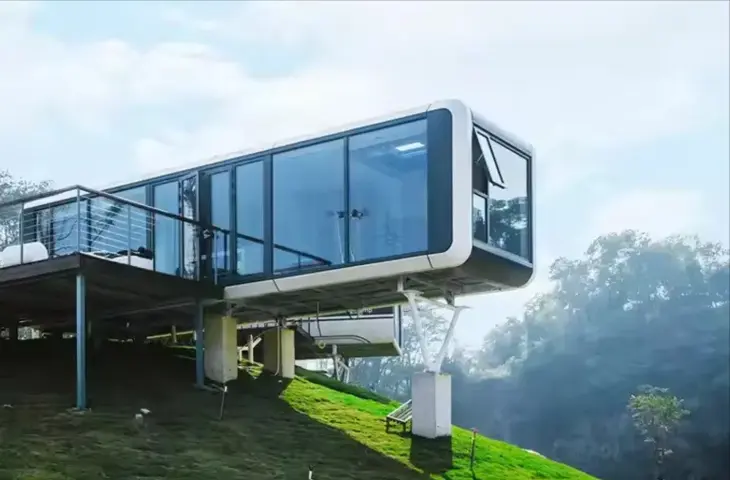
The global market for prefabricated small homes is expanding as buyers look for more flexible ways to create accommodation, leisure spaces, and compact modular buildings. For international buyers, tiny homes from China offer an opportunity to explore different product designs, factory customization options, and manufacturing solutions in one sourcing market.
Among these options, capsule homes have attracted attention for their distinctive appearance, integrated interior layouts, and suitability for outdoor accommodation projects.
However, finding a suitable capsule home for sale involves more than comparing product photos or asking for the lowest factory price. Buyers need to understand the differences between available models, evaluate their intended use, check product specifications, and consider how the unit will be transported and installed.
At PodVoyager, we manufacture capsule houses and customized modular accommodation solutions in Linyi, Shandong, China. We work with international buyers who need more than a standard small house, helping them explore suitable configurations for hospitality, tourism, and commercial projects.
This article explains what to consider when sourcing tiny homes from China and how to choose a capsule home that fits your actual requirements.
1. Why Are Buyers Sourcing Tiny Homes from China?
China has become an important sourcing destination for prefabricated buildings and modular accommodation products. For overseas buyers, working with a Chinese manufacturer can provide access to different product configurations, manufacturing capabilities, and customization options.
But the value of sourcing from China is not simply about finding a lower purchase price.
More Product Options for Different Applications
The term tiny home covers a broad range of products. Depending on the manufacturer, buyers may find compact prefabricated houses, modular cabins, portable accommodation units, and capsule-style buildings.
These products are not interchangeable.
A small cabin designed for occasional residential use may have a very different layout from a capsule house intended for a resort. A commercial accommodation unit may also require integrated bathroom facilities, climate control, electrical systems, and more durable interior finishes.
The first step is therefore to identify the actual purpose of the building rather than searching for a product based only on its appearance.
Factory Customization
One advantage of working directly with a manufacturer is the possibility of discussing product adjustments before production.
Depending on the product and manufacturing capability, customization may involve:
- Interior layout and functional areas
- Exterior appearance and color
- Window size and configuration
- Interior materials and finishes
- Bathroom and kitchen arrangements
- Electrical and equipment options
- Heating, cooling, and insulation requirements
Not every manufacturer supports every customization request. Buyers should confirm which options are standard, which require additional engineering, and which may affect production time or cost.
A More Flexible Approach to Project Development
For commercial buyers, a tiny home is often one component of a larger development.
A resort may need several guest accommodation units. A tourism operator may want to create a small cluster of independent cabins. A property developer may need modular spaces for temporary or permanent commercial use.
Factory-produced units can make it easier to plan repeated configurations and phased procurement, provided that transportation, site conditions, local approvals, and installation requirements are addressed in advance.
The real advantage is the ability to match the building to the project instead of forcing the project to fit a standard product.
2. Tiny Homes vs. Capsule Homes: Which One Should You Buy?
Although tiny homes and capsule homes are sometimes discussed together, they do not always refer to the same type of building.
A tiny home generally describes a compact living space. It may look like a traditional small house, a portable cabin, or a prefabricated modular building.
A capsule home is more closely associated with a modern, factory-built structure with an integrated architectural design. Many capsule houses are developed specifically for hospitality and outdoor accommodation.
The distinction matters because the intended use affects the product specifications.
| Buying consideration | General Tiny Home | Capsule Home |
|---|---|---|
| Main design concept | Compact house or cabin | Integrated modular structure |
| Common applications | Small living spaces, cabins, holiday accommodation | Glamping resorts, scenic accommodation, hospitality projects |
| 外觀 | Often resembles a conventional small house | Often features contemporary architecture and large glazed areas |
| Interior planning | Depends on the floor plan and building size | Often designed around an integrated accommodation layout |
| Project considerations | Living requirements, utilities, local building regulations | Guest experience, site layout, transportation, installation and operations |
Neither category is automatically better. The right choice depends on the project.
If you want a compact building that resembles a conventional house, a traditional tiny home may be appropriate.
If you are developing a nature resort, glamping site, or distinctive hospitality destination, a capsule home may offer a more suitable architectural and accommodation concept.
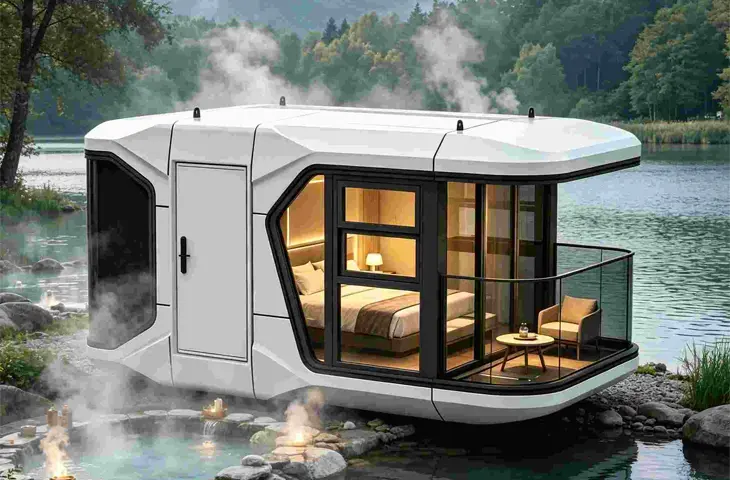
3. What Should You Look for When Choosing a Capsule Home for Sale?
When searching for a capsule home for sale, it is easy to focus on exterior design. However, a product that looks impressive in photographs may not necessarily meet your project’s operational requirements.
A more practical evaluation starts with the following considerations.
Interior Layout and Functional Configuration
Think about how guests or users will occupy the space.
For a hospitality project, the basic requirements may include a sleeping area, bathroom, storage, and a comfortable living environment. Depending on the target market, you may also need a kitchenette, private terrace, or additional seating area.
For example, a couple-oriented accommodation unit may prioritize a comfortable bed, bathroom, and panoramic views. A family-oriented unit may require additional sleeping capacity and a more flexible interior layout.
Do not assume that a larger exterior automatically means a more practical interior. Ask for floor plans and confirm the actual usable space.
Structural Materials and Insulation
The structure and exterior materials influence durability, maintenance, and suitability for different climates.
When evaluating a product, ask the manufacturer about:
- Main structural frame materials
- Exterior cladding and corrosion protection
- Wall, roof, and floor construction
- Insulation materials and thickness
- Window and door specifications
- Waterproofing and drainage arrangements
Climate conditions should be considered before the product configuration is finalized.
A capsule home intended for a cold destination may need different insulation, glazing, heating, and sealing arrangements from a unit installed in a warm coastal environment.
Buyers should also check whether the proposed specifications satisfy the building, safety, and energy requirements applicable in their destination country.
Bathroom, Electrical, and Climate-Control Systems
For commercial accommodation, integrated systems can have a major influence on the guest experience and operating requirements.
Confirm whether the selected model includes a bathroom, hot-water system, lighting, electrical distribution, air conditioning, ventilation, or other equipment.
Also clarify what is included in the factory delivery and what must be completed on site.
For example, a unit may be manufactured with internal plumbing connections, but the buyer may still need to arrange external water supply, drainage, and electrical connections.
A detailed specification sheet is much more useful than a general statement that a product is fully equipped.
4. Explore Capsule Home Options from PodVoyager
PodVoyager develops capsule houses and modular accommodation solutions for international hospitality and commercial projects.
Rather than treating every buyer’s requirement as identical, we consider the intended use, site conditions, accommodation requirements, and preferred configuration when discussing a suitable product.
Here are two product options worth exploring.
Glamp V3: A Compact Modular Accommodation Option
該 Glamp V3 is a compact capsule-style product designed around modular use.
Its published specifications include an earthquake-resistant steel main frame, 100 mm polyurethane spray-foam insulation, thermal-break doors and windows, and double-tempered hollow glass.
The product also offers an integrated kitchen configuration, making it an option to consider when planning compact accommodation or small modular living spaces.
For buyers, the important point is to evaluate the actual configuration against the intended application. Confirm the floor plan, equipment list, utility connections, and any required modifications before requesting a final quotation.
Glamp V8: A Resort-Oriented Capsule House
<text color=”secondary” size=”xs”>Product option for nature-based hospitality projects</text>
該 Glamp V8 is designed around the experience of staying close to nature while maintaining the comfort expected from a hotel-style accommodation unit.
For resort developers, the product can also serve as the basis for larger modular configurations.
The V8 can be combined into configurations such as the Glamp 傾斜疊放三連組 以及 Glamp 雙層四模組帳篷.
This creates additional possibilities for projects that need different accommodation capacities or want to introduce architectural variety across a resort.
The choice between a compact unit and a larger configuration should be based on guest capacity, land conditions, project positioning, and the total delivery budget.
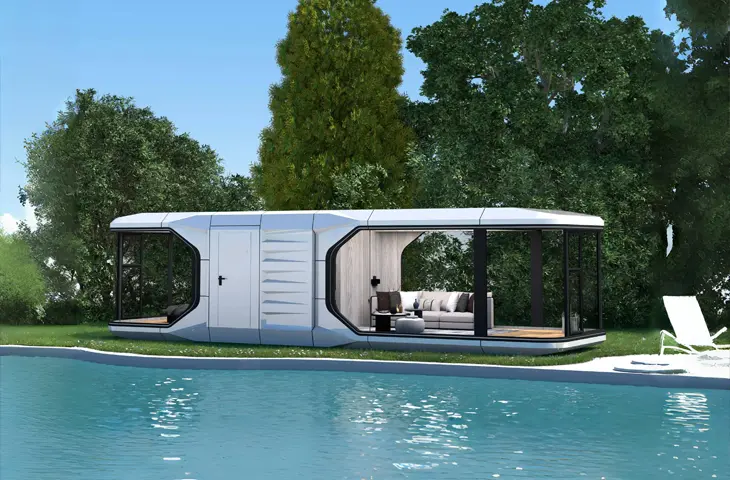
5. How to Buy Tiny Homes from China: What International Buyers Should Check
Finding a product online is only the beginning of the purchasing process. International buyers should also evaluate the manufacturer and confirm the details that will affect production, transportation, and final delivery.
Verify the Manufacturer’s Actual Capabilities
Before placing an order, ask for information that helps you understand how the product is manufactured.
Useful materials may include:
- Factory photographs and production videos
- Product specification sheets
- Structural and material details
- Manufacturing process information
- Quality inspection procedures
- Photographs of completed products
- References or documented project cases, where available
Do not rely entirely on promotional images. Ask questions about the actual construction and materials behind the finished appearance.
Confirm What Is Included in the Quotation
A capsule home quotation should identify the product configuration and the scope of supply.
Ask whether the price includes the main structure, exterior finishes, interior decoration, bathroom equipment, electrical systems, furniture, and other selected options.
It is equally important to identify exclusions.
International transportation, destination port charges, customs clearance, import duties, inland delivery, lifting, and installation may need to be budgeted separately depending on the contract.
A low factory price does not necessarily mean a lower total project cost.
Consider Shipping and Installation Before Ordering
Capsule homes are prefabricated products, but they still need to be transported and installed under suitable conditions.
Before confirming an order, discuss the packaged dimensions, gross weight, loading method, destination port, and delivery requirements.
For the project site, check road access, unloading space, lifting equipment, foundation preparation, and utility connections.
These factors should be considered during product selection, not after the unit has completed production.
Check Local Building and Import Requirements
A product manufactured in China does not automatically satisfy the building or accommodation regulations of every destination country.
Depending on the application and location, buyers may need to verify structural requirements, fire safety, electrical standards, energy performance, plumbing requirements, planning permission, and import documentation.
The relevant requirements should be checked with local authorities or qualified professionals before ordering.
This is particularly important when capsule homes will be used as permanent accommodation or commercial hospitality buildings.
6. Are Capsule Homes Suitable for Commercial Projects?
A capsule home can be more than a standalone small building. In the right project, it can become part of a repeatable accommodation or modular space system.
For example, a hospitality developer may start with several units to test a new accommodation concept. Once the project attracts sufficient demand, additional units can be introduced in another phase.
A resort might also combine different configurations to serve different guest segments.
Some units may be designed for couples, while larger configurations can accommodate families or premium guests. The overall development can also include reception buildings, service spaces, and other supporting facilities.
This approach allows the developer to think beyond individual product purchases.
The project should be planned as a complete operating environment, including accommodation, guest movement, utilities, service access, and future expansion.
For PodVoyager, this is an important part of modular development: understanding what space a customer needs and how that space can be manufactured, transported, installed, and used.
7. Request a Capsule Home Quotation from PodVoyager
If you are searching for tiny homes from China or comparing a capsule home for sale, the most effective way to start is with your actual project requirements.
Instead of requesting a price based only on a product photograph, prepare the information that will help the manufacturer recommend a suitable configuration.
Before requesting a quotation, consider providing:
- Intended application: private use, resort accommodation, glamping, or commercial space
- Preferred model or reference design
- 所需數量
- Expected room layout and guest capacity
- Destination country and project location
- Local climate and site conditions
- Preferred equipment and interior configuration
- 預計交貨時間表
Based in Linyi, Shandong, China, PodVoyager manufactures capsule houses and customized modular accommodation solutions for international buyers.
Whether you need a compact modular unit, a resort-oriented capsule house, or a larger multi-module configuration, we can discuss the product and project requirements with you.
Explore the PodVoyager product range 或 聯絡我們的團隊 to discuss your project and request a quotation.
常見問題
Can I buy tiny homes directly from China?
Yes. International buyers can source prefabricated tiny homes and capsule houses from Chinese manufacturers. Before purchasing, verify the manufacturer’s capabilities, product specifications, customization options, export arrangements, and the requirements for importing the product into your country.
What is the difference between a tiny home and a capsule home?
A tiny home is a broad term for a compact living space or small prefabricated house. A capsule home is generally a more integrated modular structure, often featuring contemporary architecture and layouts designed for hospitality or accommodation applications. The exact differences depend on the manufacturer’s product range.
What should I check before buying a capsule home for sale?
Check the floor plan, usable space, structural materials, insulation, windows, bathroom configuration, electrical systems, and climate-control equipment. You should also confirm packaging dimensions, transportation arrangements, installation requirements, and local building regulations.
Can capsule homes be customized?
Customization depends on the manufacturer’s production capabilities and the selected model. Possible areas to discuss include exterior appearance, interior layout, window configuration, materials, bathroom equipment, electrical systems, and other functional requirements. Buyers should confirm which options are available and whether they affect the price or production schedule.
Are tiny homes from China suitable for resort projects?
They can be suitable for resort and glamping developments when the selected design meets the project’s accommodation requirements, local regulations, climate conditions, and site constraints. Developers should evaluate guest capacity, interior facilities, transportation, installation, and long-term maintenance before selecting a product.
Does the factory price include shipping and installation?
Not necessarily. The factory price may cover only the manufactured product and specified equipment. International freight, destination charges, customs duties, inland transportation, lifting, and installation may be quoted separately. Always confirm the exact scope of supply and delivery responsibilities before signing a contract.
