
When purchasing a capsule house from China, the factory price is only one part of the total project budget. For resort developers, glamping operators, hotel investors, and modular building buyers, the capsule house shipping cost can also include inland transportation, export handling, ocean freight, destination port charges, customs clearance, import duties, and delivery to the installation site.
These costs vary depending on the capsule house model, shipment dimensions, order quantity, destination country, shipping arrangements, and local import requirements. A quotation that looks attractive at the factory level may not represent the actual cost of getting the unit ready for use.
PodVoyager helps international buyers explore capsule house and modular accommodation solutions for commercial projects. Understanding the logistics process before placing an order makes it easier to compare quotations, coordinate delivery, and prepare the site for installation.
1. What Determines Capsule House Shipping Costs from China?
There is no single shipping rate that applies to every capsule house. The most reliable estimate comes from the product specifications, destination, and delivery requirements of the actual project.
Product Dimensions, Weight, and Packaging
The dimensions and weight of a capsule house directly influence how it can be transported. Buyers should confirm the packaged dimensions and gross weight rather than relying only on the product’s exterior measurements.
The packaging method also matters. A unit may require protective materials, structural support, or specific loading arrangements to reduce the risk of damage during handling and transit.
Depending on the product design and transport limitations, a shipment may require a particular container arrangement or another suitable transport solution. Buyers should ask the manufacturer and freight forwarder to confirm the proposed loading plan before accepting a shipping quotation.
For projects involving multiple capsule houses, request a shipment plan showing how the units will be packed and transported. This provides a more reliable basis for estimating the cost per unit.
Shipping Route and Destination Port
The shipping route is another major factor in the overall capsule house shipping cost. Freight rates depend on the origin and destination ports, available services, cargo specifications, market conditions, and the date of shipment.
The destination port should also be selected with the final project location in mind. A port that offers an attractive ocean freight rate may not be the most economical option if inland transportation to the resort or construction site is expensive.
Before comparing quotations, confirm the following information:
- The Chinese port of departure
- The destination port or nearest suitable port
- The proposed shipping method
- The estimated transit time
- The validity period of the freight quotation
- Any stated exclusions, surcharges, or additional handling requirements
Ocean freight rates can change. A quotation should therefore be treated as time-specific rather than as a permanent price for future orders.
Order Quantity and Loading Efficiency
The number of capsule houses in an order affects the overall shipping arrangement, but shipping costs do not necessarily decrease in direct proportion to order quantity.
For example, several units may share certain transportation or handling costs, while larger dimensions or additional shipments may create new expenses. The final result depends on how the products can be loaded, the number of shipments required, and the services included in the quotation.
For a resort development, buyers should compare the total logistics cost for the planned order rather than simply multiplying a single-unit estimate by the number of units.
It is also worth discussing phased delivery. If a project will be developed in stages, the buyer should compare the cost and operational implications of shipping all units together against arranging multiple deliveries.
2. What Costs Are Included Beyond Ocean Freight?
Ocean freight is only one part of the international transportation process. To understand the full capsule house import cost, buyers need to identify the expenses incurred before departure, during international shipping, at the destination port, and between the port and the project site.
| Cost item | What buyers should confirm |
|---|---|
| Factory-to-port transportation | Whether domestic transport from the factory to the departure port is included |
| Export packaging and loading | Whether protective packaging, loading, and cargo securing are included |
| Export customs clearance | Who arranges export declarations and the associated services |
| Морские перевозки | Which route and shipping service are quoted, and what the rate includes |
| Destination port charges | Whether terminal handling, documentation, and other applicable port fees are included |
| Customs clearance service | Whether a local customs broker is required and who pays the service fee |
| Import duties and taxes | Which duties and taxes apply under the destination country’s rules |
| Destination inland transport | Whether delivery from the port to the project site is included |
| Unloading and lifting | Whether cranes, lifting equipment, and on-site unloading are included |
| Installation and connections | Whether assembly, positioning, and utility connections are included |
This table is a budgeting checklist, not a statement that every shipment will incur every charge. Some costs may be bundled into a supplier’s quotation, while others may be billed separately by freight forwarders, customs brokers, port operators, or local contractors.
The key is to understand the scope of each quotation before comparing prices.
Why Destination Port Charges Matter
Buyers sometimes compare two suppliers based on the quoted ocean freight alone. This can be misleading because destination-side costs may not be included in the freight rate.
Depending on the shipment and local arrangements, destination expenses may include terminal handling, documentation, cargo release, customs-related services, storage, or other applicable charges. The exact items and amounts depend on the port, service provider, shipment, and contract terms.
Ask the freight forwarder for a breakdown of the destination charges and identify which amounts are confirmed and which may change. Also ask how long the cargo can remain at the port or terminal before storage or other time-related charges may apply.
This is especially important when coordinating delivery to a resort site, where unloading equipment, site access, and installation teams may need to be scheduled in advance.
3. Customs Clearance, Import Duties, and Taxes
Import requirements can significantly affect the total capsule house import cost. However, customs procedures and tax rates differ by destination country, product classification, and the details of the shipment.
Buyers should confirm import requirements before finalizing their purchasing and shipping arrangements.
Confirm the Product Classification
A capsule house may contain a combination of structural components, exterior panels, glazing, interior finishes, and electrical or plumbing systems. Its customs classification should not be assumed solely from the commercial name “capsule house.”
The correct classification depends on the actual product, its construction, configuration, and the applicable customs rules. Buyers should work with a qualified customs broker or the relevant customs authority to determine the appropriate classification for their specific shipment.
Do not rely on a generic online tariff rate without confirming that it applies to the product being imported.
Prepare the Required Shipping Documents
The documents required for import depend on the destination country’s rules and the shipment arrangement. Common documents may include:
- Commercial invoice
- Packing list
- Bill of lading or other applicable transport document
- Certificate of origin, where required or applicable
- Product specifications and supporting technical documents
- Additional declarations, permits, or compliance documents required by the importing country
Buyers should confirm the exact requirements with their customs broker before shipment. If the destination country requires product-specific documentation or compliance evidence, it is better to identify those requirements before production and dispatch.
The manufacturer and freight forwarder should also agree on who prepares each document and who checks its accuracy.
Calculate Duties and Taxes Separately
Import duties, import VAT, GST, and other applicable taxes are not the same as customs clearance service fees.
The amount payable may depend on the product classification, customs value, country of origin, applicable trade measures, and local tax rules. The calculation method and available exemptions or preferential arrangements also vary by jurisdiction.
For an accurate estimate, buyers should obtain confirmation from a local customs broker or tax professional based on the specific product and destination.
PodVoyager buyers should not treat an estimated freight quotation as confirmation of the final import tax liability. These amounts should be verified separately before the purchasing budget is finalized.
4. Shipping a Capsule House from the Port to the Project Site
Arriving at the destination port does not mean that a capsule house is ready for installation. The final transportation stage can be particularly important for resort developments located in rural areas, mountains, forests, coastal regions, or other sites with restricted access.
Check Site Access Before Shipping
Before production is completed, buyers should assess whether the delivery vehicle can reach the intended installation area.
Important considerations include road width, turning space, bridge or overhead clearance, road load restrictions, slopes, access gates, and temporary construction routes. Where necessary, the transport provider should inspect the route or review suitable site information before confirming the delivery arrangement.
A route that works for ordinary trucks may not be suitable for a larger or heavier unit. If special vehicles or permits are required, these arrangements should be included in the project budget and schedule.
Plan Unloading and Lifting
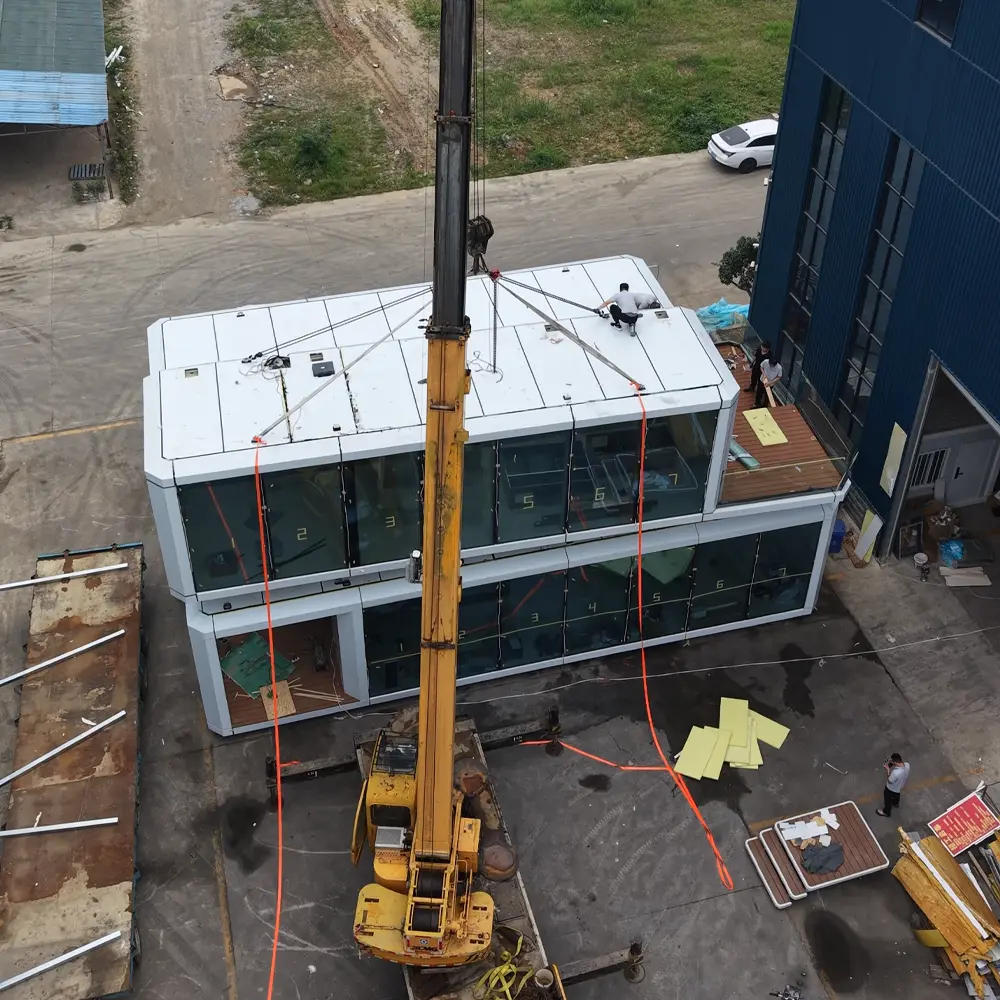
Capsule houses may require lifting equipment to unload, position, or install them, depending on the product design and delivery method.
Buyers should confirm the unit’s lifting points, weight, dimensions, and handling requirements with the manufacturer. The lifting plan must be suitable for the actual product and site conditions.
The project team should also establish who is responsible for arranging the crane, coordinating the delivery vehicle, preparing the unloading area, and managing on-site safety.
If several units are being delivered, the sequence of unloading and installation should be coordinated with the site layout. This can help avoid unnecessary handling, temporary storage, and conflicts between transport vehicles and installation teams.
Include Site Preparation and Utility Connections
Transportation and installation are related but separate parts of a modular accommodation project.
Before delivery, the buyer should confirm that the required foundations or support points are ready and that the site can accommodate the unit according to the manufacturer’s specifications.
Water supply, drainage, electrical connections, and other utilities should also be planned in advance where applicable. The exact requirements depend on the selected model and its configuration.
A complete project budget should distinguish between the cost of transporting the unit, placing it on site, completing any required assembly, and connecting the necessary utilities. Do not assume that all these services are included in the factory price.
5. How to Estimate the Total Capsule House Import Cost
For commercial buyers, the most useful approach is to calculate the cost from the factory to the point where the capsule house is ready for its intended use.
A practical budgeting formula is:
Estimated Project Delivery Cost =
- Capsule house purchase price
- Factory-to-port transportation
- Export packaging and handling
- Export customs-related costs
- International freight
- Destination port charges
- Customs broker and clearance service fees
- Applicable import duties and taxes
- Inland transportation to the project site
- Unloading and lifting
- Installation and assembly, where required
- Site preparation and utility connections
This formula should be adapted to the actual quotation and delivery arrangement. Some items may already be included in the purchase price or freight quotation, and others may not apply to a particular project.
For example, a supplier’s quotation may cover the product and export preparation but exclude destination port handling, import taxes, local transportation, and installation. Another quotation may include a broader delivery scope. Comparing the headline prices without checking these differences can lead to an inaccurate cost assessment.
For a resort project with multiple accommodation units, buyers should also consider whether the delivery plan matches the construction schedule. Delays caused by incomplete site preparation or unconfirmed customs requirements can create additional costs even when the original freight rate was competitive.

6. How to Compare Shipping Quotations from Different Suppliers
When requesting quotations for shipping a capsule house from China, provide the same information to each supplier or freight forwarder. This makes the resulting estimates easier to compare.
At a minimum, prepare the following:
Product information
- Selected capsule house model
- Product dimensions and weight
- Packaged dimensions and gross weight
- Order quantity
- Any special handling or loading requirements
Shipping information
- Destination country and city
- Preferred destination port, if known
- Required delivery schedule
- Whether the quotation should cover only port-to-port shipping or delivery to the project site
Project information
- Site address or location
- Road access and unloading conditions
- Whether lifting equipment is required
- Whether installation or technical support is needed
- Any known import documentation or compliance requirements
Ask each provider to state what is included, what is excluded, which charges remain estimates, and how long the quotation is valid.
It is also useful to confirm the agreed delivery terms under the contract. International commercial terms help define the division of responsibilities, costs, and risks between the seller and buyer, but the precise obligations depend on the term selected and the named place or port. Buyers should review the applicable term and contract wording rather than assuming that a phrase such as “shipping included” covers every expense through final installation.
7. Plan Your Capsule House Shipment with PodVoyager
For overseas resort developers, glamping operators, and commercial project owners, shipping should be considered during project planning—not after the capsule houses have been manufactured.
The selected model, order quantity, packaging, destination port, site access, and installation requirements all influence the delivery arrangement. Confirming these details early helps buyers obtain more relevant quotations and coordinate logistics with site preparation.
PodVoyager manufactures capsule houses and modular accommodation solutions for a range of commercial applications. Buyers can explore the available models and discuss their project requirements before confirming product specifications and delivery arrangements.
To request a project-specific quotation, prepare your preferred model, order quantity, destination country, delivery location, and any known site requirements.
Visit the Сайт PodVoyager to explore its modular accommodation solutions, or contact the PodVoyager team to discuss your project and request a quotation.
Часто задаваемые вопросы
How much does it cost to ship a capsule house from China?
The cost depends on the product’s dimensions and weight, packaging, order quantity, shipping route, destination port, and required delivery services. Destination port charges, customs clearance, import duties, inland transportation, lifting, and installation may add to the total. An accurate estimate requires the specifications of the actual product and the destination details.
Does the capsule house shipping cost include customs duties and taxes?
Not necessarily. Ocean freight, customs clearance services, import duties, and taxes are separate cost categories, although a particular quotation may bundle some services together. Buyers should confirm the scope of the quotation and verify applicable duties and taxes with a customs broker in the destination country.
Can I calculate the shipping cost using only the number of capsule houses?
The quantity is important, but it is not enough on its own. Shipping calculations also require product dimensions, weight, packaging details, loading arrangements, and destination information. Two orders containing the same number of units may have different transportation requirements.
Who arranges inland transportation after the capsule house arrives at the destination port?
This depends on the sales contract and logistics arrangement. The seller, buyer, or a freight forwarder may coordinate the service. Before placing an order, confirm who is responsible for cargo release, local transportation, unloading, and delivery to the installation site.
Is installation included in the capsule house purchase price?
Installation should be confirmed separately unless the quotation explicitly includes it. Buyers should clarify whether the scope covers unloading, lifting, positioning, assembly, utility connections, and on-site technical support. The requirements depend on the selected model and the conditions at the project site.
What information do I need to request an accurate shipping quotation?
Prepare the capsule house model, quantity, product and packaging dimensions, gross weight, destination country, destination port if known, delivery location, and expected schedule. Also identify whether you need port-to-port shipping, delivery to the site, lifting, or installation support. Providing this information helps the supplier and freight forwarder assess the actual logistics requirements.
