
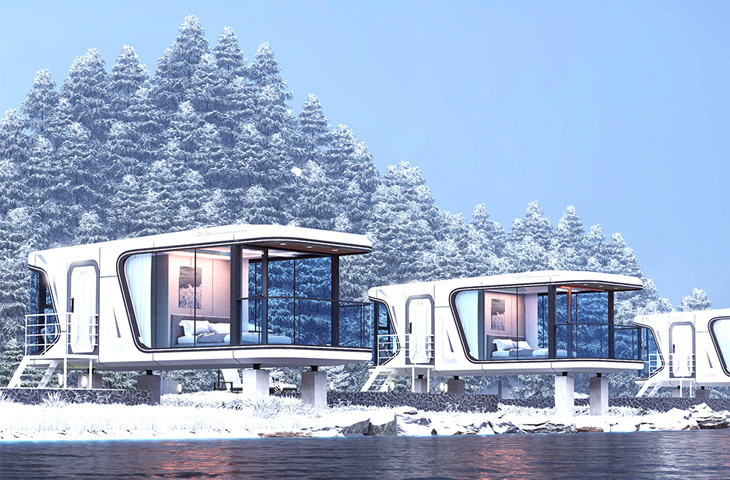
Why winter and rainy season drive maintenance costs up (and what operators can control)
For capsule house resorts (glamping resorts, eco-lodges, scenic area hotels, and modular hospitality projects), the biggest maintenance expenses rarely come from “one big failure.” They come from many small issues repeating across multiple units:
- extra cleaning time after every storm
- condensation complaints and emergency call-outs
- water splashing and mud tracking at entrances
- blocked drainage and standing water around foundations
- sealant deterioration accelerated by freeze–thaw cycles
- HVAC performance drops due to snow, debris, humidity, or poor access
The good news: most winter and rainy-season maintenance costs can be reduced through operations design—meaning routines, site layout, predictable water management, and simple staff habits—rather than expensive reconstruction.
This guide is written for owners and operations managers who want a realistic plan to reduce OPEX and keep units guest-ready during the most demanding seasons.
SEO keywords covered naturally:
capsule house resort maintenance, glamping resort operations winter, rainy season maintenance costs, reduce OPEX modular resort, condensation control capsule house, roof drainage management prefab cabins, preventive maintenance checklist capsule houses.
1) The “maintenance cost equation” for capsule resorts
Maintenance cost in winter and rainy season is usually a combination of:
- Frequency (how often issues happen)
- Labor time (minutes per unit per incident)
- Urgency (emergency call-outs cost more)
- Downtime (lost nights and refunds)
- Repeatability (same issue across multiple units)
Operators often focus on “fixing a problem” once it appears. But the highest ROI comes from reducing frequency and labor minutes per unit.
That’s exactly what the next sections target.
2) Control water first: predictable drainage = less cleaning + fewer surprises
Why uncontrolled roof runoff increases cost
In heavy rain or wet snow, roof runoff can:
- splash dirt onto exterior panels and windows
- create wet, slippery walkways near doors
- cause mud tracking into rooms
- generate repeated cleaning, staining, and guest complaints
Over a season, the labor cost of “extra cleaning after every storm” can exceed the cost of many preventive measures.
A practical upgrade: roof water diverter strip (挡水条)
One simple solution we provide for some projects is a roof water diverter strip installed on the roof. Its function is operational—not decorative:
- rainwater does not scatter everywhere
- runoff is guided to a designated area
- cleaning becomes easier because staff know exactly where water will accumulate and where to clear debris
This approach reduces:
- random splash zones
- unpredictable mud patterns
- time spent cleaning multiple areas
Operational tip: once runoff is directed, make the designated drainage zone “service-friendly”:
- gravel bed or hard surface
- slight slope away from entrances
- easy access for staff to clear leaves/sand
This is a practical way to reduce labor minutes without making unrealistic claims like “no maintenance required.”
3) Build a storm-proof cleaning workflow (so you don’t pay overtime)
Many resorts clean reactively: “it rained, clean everything.” That’s expensive.
Instead, use a priority-based workflow after rain/snow:
Step A: Safety first (5–10 minutes per cluster, not per unit)
- check slippery zones near entrances
- check stairs/ramps
- clear visible pooling areas
Step B: Quick exterior pass (only on the dirt paths)
- wipe/spot-clean the areas most visible to guests (entry, windows near seating, front-facing panels)
- skip low-visibility areas unless there is staining buildup
Step C: Interior “humidity hotspots”
After rainy weather, focus on:
- bathroom area (ventilation and wet surfaces)
- window corners (condensation)
- entry mat zone (mud and moisture)
By standardizing this workflow, you avoid the expensive mistake of doing “full cleaning for every unit after every storm.”
4) Condensation management: reduce guest complaints and emergency call-outs
Condensation is one of the most common winter/rainy season issues in small hospitality units. It creates:
- foggy windows
- dripping water at frames
- damp smell complaints
- “Is it leaking?” customer messages at night
Every complaint costs staff time, and it escalates quickly if guests panic.
What operators can do (without unrealistic engineering claims)
Condensation prevention is mainly:
- ventilation behavior
- bathroom steam control
- stable heating
- basic monitoring
Practical steps that reduce call-outs:
- Place a simple guest card:
- “After shower: turn on bathroom fan for 20–30 minutes.”
- Train housekeeping to check:
- fan working? vents blocked? curtains sealing window airflow?
- Keep a low-cost hygrometer in one or two units to spot seasonal patterns (optional but useful).
- Avoid huge temperature swings: big swings cool surfaces and increase dew-point issues.
This doesn’t “eliminate condensation forever,” but it reduces complaints and reduces the number of “urgent night calls” that cost the most.
5) Preventive maintenance beats repairs: a realistic checklist schedule
A good resort operation uses short, repeatable checklists that staff can perform without specialists.
Winter / rainy season checklist (operator-friendly)
Weekly (per unit cluster, not necessarily every single unit)
- drainage outlets clear (roof runoff path, ground drains)
- window tracks clean, drainage holes not blocked
- door thresholds clean and sealing properly
- bathroom fan working, filter not clogged (if applicable)
Monthly
- visual check of exterior seams and trims
- check for any recurring splash stains or pooling zones
- inspect entry steps/ramps and anti-slip materials
- check HVAC outdoor area is not blocked by debris/snow
After heavy storms
- quick roof runoff observation (does water drain to the intended zone?)
- check for water pooling around foundations
- check the most exposed units first (windward side)
The key is not perfection. The key is consistency.
6) Spare parts planning: cut costs by avoiding “waiting + express shipping”
For resorts, maintenance cost includes not only repairs but procurement time. If you wait for a part, you may lose bookings.
A realistic spare-parts kit can reduce downtime:
- common fasteners and sealant supplies
- spare door seals / gasket strips (high-wear items)
- basic plumbing consumables (if applicable)
- a spare exhaust fan or fan motor (for high-occupancy units)
- spare remote controls / switches (common guest loss)
You don’t need a “warehouse.” You need a small, smart kit that prevents emergency procurement.
7) Staff training and guest instructions: the cheapest cost reduction
A surprising percentage of “maintenance” issues are actually usage issues:
- guests don’t turn on bathroom ventilation
- windows are kept fully sealed in rainy season while drying clothes inside
- heaters are turned off completely during the day, then maxed at night
- entry mats not used → more mud inside → more cleaning
Two low-cost solutions:
- A simple guest guide (one page, icons, bilingual if needed)
- A staff checklist at check-in/checkout (fan on/off, windows, HVAC, basic drainage observation)
These reduce:
- condensation complaints
- odor complaints
- cleaning workload
- wear-and-tear from misuse
8) Site layout and landscaping: reduce water and mud at the source
If your resort is in a rainy region, the land itself can create extra cleaning costs.
Practical site improvements with high ROI:
- hard paths or gravel paths to each unit (reduces mud tracking)
- simple drainage channels to move water away from entrances
- entry platforms that stay dry
- vegetation barriers to reduce wind-driven splash (in some locations)
Even a small improvement in “mud control” can save hundreds of cleaning hours over a season in multi-unit resorts.
9) Winter-specific OPEX reductions: snow, ice, and freeze–thaw routines
Winter brings different cost drivers:
- snow removal around entrances
- ice risk on steps and walkways
- freeze–thaw stress on sealants and joints
- HVAC outdoor unit blockage
Practical winter operations routine
- Clear snow from entry zones early (safety + less tracked water inside)
- Keep a standard de-icing strategy (approved materials for your surfaces)
- Check outdoor equipment airflow paths
- After thaw cycles, observe whether water is pooling near foundations
Again, the goal is to reduce frequency and emergency incidents.
10) Design-for-operations: choose upgrades that cut labor, not only “look premium”
When ordering or configuring capsule houses for a resort, prioritize upgrades that reduce recurring labor:
- better water routing (roof runoff control / diverter concept)
- easier-to-clean exterior surfaces and trims
- durable seals around openings
- access-friendly equipment placement (HVAC service access)
- interior finishes that tolerate moisture and frequent turnover
The best “ROI upgrades” are not always the most expensive. They are the ones that reduce repeated tasks across dozens of units.
Cost-saving FAQ (real operator questions)
What is the fastest way to reduce rainy-season maintenance cost?
Make water behavior predictable: control roof runoff, improve drainage around entrances, and adopt a storm cleaning workflow.
Why do small issues become expensive in resorts?
Because the same issue repeats across multiple units, multiplied by occupancy turnover and staff time.
Is condensation mainly a design problem?
Often it’s an operations problem: ventilation habits, bathroom steam control, and stable heating. Design matters, but operations usually deliver the fastest cost reduction.
What should we track to prove savings?
Track:
- staff cleaning hours after storms
- number of guest complaints related to humidity/condensation
- downtime nights due to maintenance
- parts purchasing frequency
Even a simple monthly record helps.
Conclusion: reduce maintenance cost by reducing repetition
Winter and rainy season don’t have to destroy your maintenance budget. The most reliable approach is operational:
- make roof runoff predictable (and easier to clean)
- manage condensation with ventilation habits and simple instructions
- use checklists to prevent small issues from repeating
- keep a small spare-parts kit to avoid downtime
- improve site drainage and paths to reduce mud and splash
- train staff and guide guests—cheap actions with high ROI
