
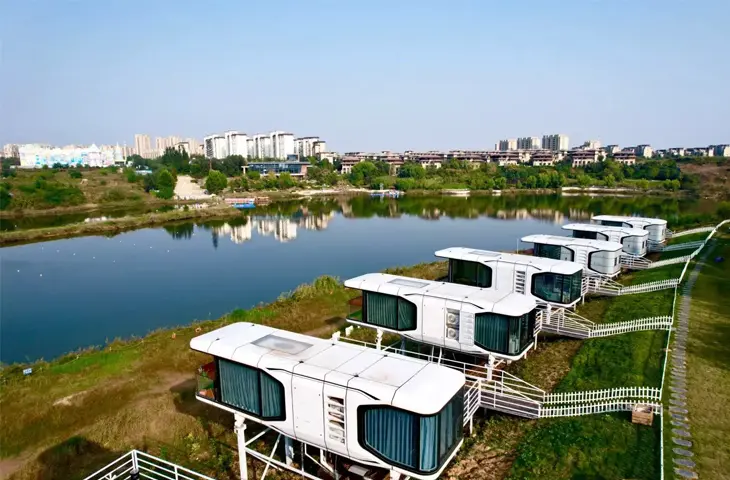
Introduction: The Imperative for Sustainable Housing Solutions
In an era increasingly defined by climate consciousness and resource scarcity, the global construction industry stands at a critical crossroads. Traditional building practices, responsible for approximately 39% of global carbon emissions and 36% of energy consumption, are undergoing necessary scrutiny and transformation. Within this context, capsule houses have emerged not merely as architectural alternatives but as pioneering solutions that fundamentally redefine the relationship between human habitation and environmental stewardship. These compact dwellings represent a convergence of intelligent design, advanced materials science, and sustainable engineering principles that collectively achieve unprecedented levels of energy efficiency while minimizing carbon footprints across their entire lifecycle.
At PodVoyager, our commitment to sustainable innovation is embedded in every aspect of our capsule house design and manufacturing processes. Operating from our advanced facility in Linyi, Shandong, we have developed proprietary methodologies that optimize energy performance while systematically reducing embodied and operational carbon emissions. This comprehensive analysis explores the multifaceted energy efficiency advantages and carbon reduction capabilities of modern capsule houses, examining how these compact dwellings are establishing new benchmarks for sustainable living in the 21st century.
Foundational Principles: Why Size and Form Factor Matter
The energy efficiency advantages of capsule houses begin with their fundamental geometry and spatial optimization. Unlike conventional housing that often prioritizes square footage over performance, capsule houses embrace an architectural philosophy where every cubic meter is carefully considered for both functional utility and thermal performance.
Surface Area to Volume Ratio Optimization
The compact nature of capsule houses creates inherently favorable surface area to volume ratios—a critical factor in thermal performance. Whereas a conventional 2,000 square foot home might expose approximately 2,800 square feet of exterior surface to environmental conditions, a comparably appointed 400 square foot capsule house reduces this exposure to approximately 1,100 square feet. This geometric efficiency translates directly to reduced thermal transfer, with mathematical modeling indicating 40-60% less surface area through which heat can escape or infiltrate depending on specific design configurations.
This reduced exposure is further optimized through strategic form factor design. PodVoyager’s engineering team employs computational fluid dynamics and thermal modeling to develop shapes that minimize wind exposure while optimizing solar gain in winter months and minimizing it during summer periods. The resulting designs achieve passive thermal advantages that significantly reduce mechanical heating and cooling demands before any active systems are even considered.
Reduced Thermal Bridging Through Integrated Design
Traditional construction often creates numerous thermal bridges—points where construction elements penetrate the insulation layer, creating pathways for heat transfer. Capsule houses manufactured in controlled factory environments allow for continuous insulation systems that wrap the entire structure without interruption. PodVoyager’s manufacturing process integrates insulation directly into structural panels, creating monolithic building envelopes that maintain consistent R-values across all surfaces. This approach typically reduces thermal bridging by 85-90% compared to conventional stick-built construction.
The integrated manufacturing approach also enables precise installation of insulation materials with consistent density and coverage, eliminating the gaps and compression that frequently degrade insulation performance in field-applied systems. Our quality control protocols verify insulation integrity at multiple production stages, ensuring that thermal performance specifications are consistently achieved in every unit produced.
Advanced Building Envelope Technologies
The building envelope represents the primary interface between interior comfort and external environmental conditions. PodVoyager capsule houses incorporate multiple advanced envelope technologies that collectively create exceptional thermal barriers while maintaining healthy indoor environments.
High-Performance Insulation Systems
Our capsule houses utilize a multi-layered insulation strategy that combines different material properties to achieve optimal performance. The standard specification includes:
- Structural insulated panels (SIPs) with expanded polystyrene cores providing R-values of R-28 to R-35 depending on climate-specific configurations
- Additional interior rigid insulation layers that eliminate thermal bridging through framing members
- Aerogel-infused blanket insulation in critical areas requiring maximum performance in minimal thickness
- Phase-change materials in select applications that absorb and release thermal energy, stabilizing interior temperatures
This composite approach creates effective R-values that typically exceed R-40 in wall assemblies and R-50 in roof systems—performance levels that conventional construction rarely achieves even with significantly thicker wall sections.
Advanced Glazing Systems
Windows represent both the greatest aesthetic feature and the greatest thermal challenge in compact dwellings. PodVoyager addresses this through carefully engineered window systems that balance views, daylighting, and thermal performance. Our standard specifications include:
- Triple-pane glazing with low-emissivity coatings on multiple surfaces
- Argon or krypton gas fills between panes
- Thermally broken aluminum or fiberglass frames
- Warm-edge spacers that minimize edge conduction losses
These systems typically achieve U-values between 0.15 and 0.22 (R-6.7 to R-4.5), with solar heat gain coefficients tailored to orientation and climate. The careful placement and sizing of windows optimizes passive solar heating in winter while minimizing unwanted heat gain in summer, contributing to a balanced annual energy profile.
Airtightness and Moisture Management
Energy efficiency depends not only on insulation value but on airtightness—the prevention of uncontrolled air infiltration. PodVoyager’s factory manufacturing enables precision joining of components that achieve exceptional airtightness, typically measuring between 0.6 and 1.0 air changes per hour at 50 Pascals pressure difference. This represents 3-5 times greater airtightness than conventional construction typically achieves.
This airtightness is complemented by intelligent moisture management systems that include vapor-permeable but water-resistant barriers, capillary breaks, and drainage planes that protect the structure while allowing incidental moisture to escape. This balanced approach prevents condensation within wall assemblies while maintaining healthy indoor humidity levels.
Integrated Mechanical Systems for Optimal Efficiency
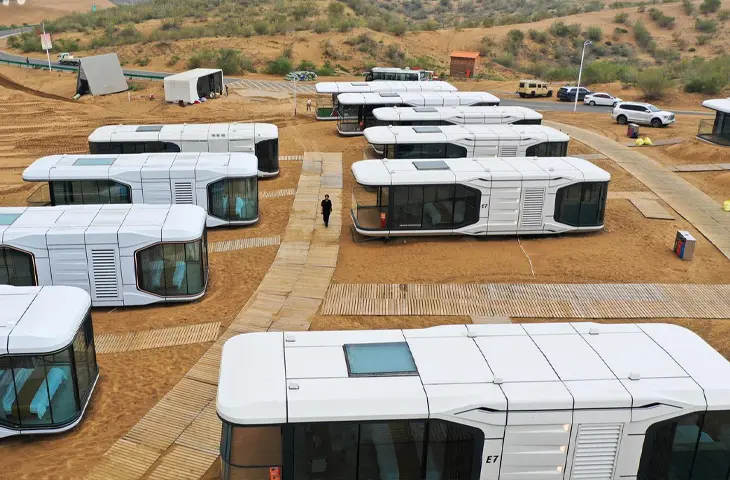
The compact nature of capsule houses enables highly efficient mechanical system design that would be impractical or cost-prohibitive in larger structures. PodVoyager’s integrated approach to mechanical systems optimizes both equipment efficiency and distribution effectiveness.
Mini-Split Heat Pump Technology
Our standard mechanical specification utilizes inverter-driven mini-split heat pump systems that achieve remarkable efficiency through several mechanisms:
- Seasonal Energy Efficiency Ratios (SEER) typically between 22 and 30, compared to 14-16 for conventional central systems
- Heating Seasonal Performance Factors (HSPF) of 10-12, compared to 7-8 for conventional systems
- Variable-speed compressors that match output precisely to demand, eliminating cycling losses
- Multiple indoor units zoned independently to condition only occupied spaces
The small interior volume of capsule houses allows these systems to maintain precise temperature control with minimal energy input, particularly when combined with the high-performance building envelope previously described.
Energy Recovery Ventilation (ERV) Systems
Maintaining indoor air quality while minimizing energy loss requires sophisticated ventilation strategies. PodVoyager integrates compact ERV systems that:
- Recover 70-85% of thermal energy from exhaust air
- Transfer moisture between streams to maintain optimal humidity
- Provide continuous fresh air with minimal fan energy consumption
- Include programmable controls that adjust ventilation rates based on occupancy
These systems ensure healthy indoor environments while adding only minimal energy penalty to the overall building performance.
Integrated Water Heating
Water heating represents a significant portion of residential energy consumption. PodVoyager addresses this through:
- Compact heat pump water heaters with coefficients of performance (COP) of 3.0-4.0
- Point-of-use electric heaters for remote fixtures to minimize distribution losses
- Optional drainwater heat recovery systems that capture energy from shower water
- Solar thermal preheat systems in appropriate climates
These approaches collectively reduce water heating energy consumption by 50-75% compared to conventional electric resistance systems.
Renewable Energy Integration and Net-Zero Potential
The energy-efficient foundation of capsule houses creates ideal conditions for renewable energy integration, enabling many installations to approach or achieve net-zero energy status.
Solar Photovoltaic Integration
PodVoyager’s roof designs are engineered to accommodate photovoltaic systems with minimal aesthetic compromise. Our approach includes:
- Roof-integrated mounting systems that maintain waterproof integrity
- Optimized tilt angles based on project latitude and climate
- Pre-installed conduit pathways that simplify installation
- Electrical system designs that accommodate both grid-tied and off-grid configurations
The reduced energy demands of capsule houses mean that relatively modest photovoltaic arrays—typically 2-4 kW depending on location and climate—can often meet or exceed annual energy requirements. Our energy modeling indicates that properly oriented capsule houses in most temperate climates can achieve net-positive energy status with roof areas between 200 and 300 square feet of photovoltaic coverage.
Battery Storage and Energy Management
For off-grid applications or enhanced resilience, PodVoyager offers integrated battery storage solutions that:
- Store excess solar generation for use during nighttime or cloudy periods
- Provide backup power during utility outages
- Enable time-of-use optimization where variable electricity rates apply
- Include sophisticated energy management systems that prioritize loads based on availability and importance
These systems transform capsule houses from efficient consumers to proactive participants in broader energy ecosystems, potentially contributing to grid stability through demand response capabilities.
Embodied Carbon Reduction Through Manufacturing Innovation
While operational energy efficiency receives significant attention, the embodied carbon in building materials and construction processes represents an equally important dimension of environmental impact. PodVoyager’s manufacturing approach systematically addresses embodied carbon through multiple strategies.
Material Selection for Carbon Minimization
Our material specification process includes comprehensive life cycle assessment (LCA) to identify options that minimize carbon impact. Key strategies include:
- Structural systems utilizing recycled steel content exceeding 75%
- Insulation materials with blowing agents that have low global warming potential
- Interior finishes incorporating rapidly renewable materials like bamboo and cork
- Exterior claddings with significant recycled content or certified sustainable sourcing
- Concrete alternatives for foundations that utilize supplementary cementitious materials
This material selection approach typically reduces embodied carbon by 30-40% compared to conventional construction using similar material categories.
Manufacturing Efficiency and Waste Reduction
Our factory-based manufacturing creates multiple carbon advantages through:
- Optimized material cutting that minimizes waste through nesting software
- Recycling programs that capture and repurpose manufacturing byproducts
- Energy-efficient production equipment with variable-speed drives and smart controls
- Consolidated transportation of components rather than multiple deliveries to construction sites
- Reduced job-site energy consumption through minimized on-site construction activity
Life cycle assessments indicate that these manufacturing efficiencies reduce the carbon footprint of the construction process by 50-60% compared to conventional site-built alternatives.
Transportation Optimization
While transportation represents a carbon cost for any manufactured product, PodVoyager’s approach minimizes this impact through:
- Strategic factory location in Shandong with excellent access to shipping infrastructure
- Container optimization that maximizes unit density per shipment
- Consolidated deliveries that serve multiple projects in geographical proximity
- Ocean transport for international delivery, which produces approximately 1/50th the carbon per ton-mile compared to air freight
For North American deliveries, our logistics analysis indicates transportation carbon represents approximately 8-12% of total embodied carbon—a proportion that continues to decrease as shipping efficiency improves and alternative fuels become more prevalent.
Lifecycle Carbon Analysis and Circular Economy Principles
PodVoyager’s sustainability commitment extends beyond initial construction to encompass the entire lifecycle of our capsule houses, including eventual decommissioning and material recovery.
Durability and Longevity
The fundamental sustainability advantage begins with longevity. Our capsule houses are engineered for:
- Structural lifespans exceeding 60 years with proper maintenance
- Exterior finishes with 25-30 year durability before significant refurbishment
- Interior systems designed for easy component replacement without structural modification
- Corrosion protection systems that prevent deterioration in challenging environments
This durability ensures that the embodied carbon is amortized over an extended useful life, reducing annualized carbon impact significantly compared to less durable alternatives.
Adaptability and Future-Proofing
Changing needs often render buildings obsolete before their structural life is complete. PodVoyager addresses this through:
- Modular designs that allow reconfiguration as needs change
- Standardized connections that facilitate additions or modifications
- Universal design principles that accommodate changing mobility requirements
- Technology pathways that accommodate future system upgrades
This adaptability extends useful life and prevents premature replacement, representing a significant carbon advantage over less flexible structures.
Design for Disassembly and Material Recovery
At end-of-life, PodVoyager’s designs facilitate material recovery through:
- Mechanical rather than chemical connections between major components
- Material identification systems that facilitate sorting during deconstruction
- Standardized material types that align with existing recycling streams
- Documentation systems that provide material inventories for future recovery operations
Our analysis indicates that 75-85% of materials by weight can be recovered for reuse or recycling at end-of-life, significantly reducing landfill impacts and creating circular material flows.
Comparative Performance Analysis
Quantifying the energy and carbon advantages of capsule houses requires comparison with conventional alternatives. Our analysis utilizes several standardized metrics to illustrate these advantages.
Energy Use Intensity (EUI) Comparison
Energy Use Intensity measures annual energy consumption per square foot. While conventional new construction in North America typically achieves EUI between 30 and 50 kBtu/sf/year, PodVoyager capsule houses routinely achieve EUI between 8 and 15 kBtu/sf/year—a reduction of 60-80%. When combined with renewable energy generation, many installations achieve net-zero or net-positive EUI, meaning they produce as much or more energy than they consume annually.
Carbon Emission Analysis
Considering both operational and embodied carbon, PodVoyager capsule houses demonstrate compelling advantages:
- Operational carbon reductions of 70-85% compared to conventional housing of equivalent function
- Embodied carbon reductions of 30-40% compared to conventional construction
- Lifecycle carbon reductions of 50-70% over a 60-year analysis period
- Potential for carbon-negative operation when combined with appropriate renewable energy and carbon sequestration strategies
These advantages become particularly significant when considering the accelerating decarbonization of electrical grids, which will further reduce operational carbon for electrically heated and cooled capsule houses.
Financial Implications of Energy Efficiency
While direct cost comparisons vary by region and application, the energy efficiency of capsule houses creates compelling financial value through:
- Utility cost reductions of 60-80% compared to conventional alternatives
- Reduced mechanical system sizing and costs due to lower loads
- Potential eligibility for energy efficiency incentives and rebates
- Enhanced asset value as energy performance becomes increasingly valued in real estate markets
- Protection against future energy price volatility through reduced consumption
These financial advantages complement the environmental benefits, creating a comprehensive value proposition that addresses both sustainability and economic objectives.
Implementation Strategies and Best Practices
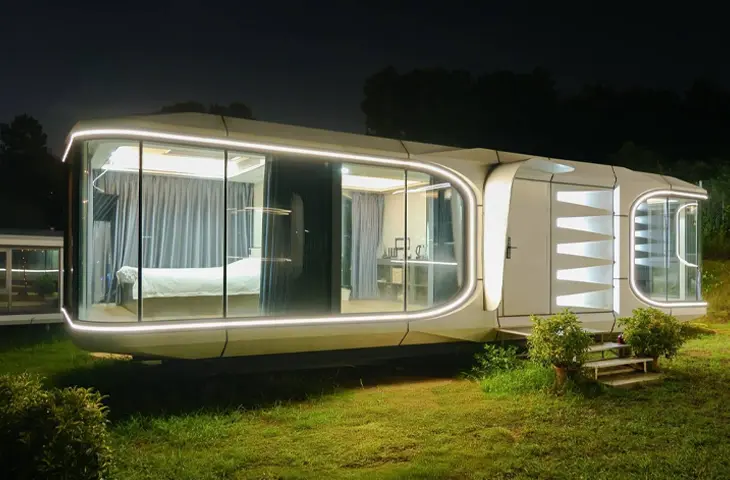
Achieving the full energy and carbon potential of capsule houses requires careful implementation. PodVoyager has developed best practices based on extensive project experience across diverse climates and applications.
Site-Specific Optimization
Energy performance depends significantly on site characteristics. Our implementation approach includes:
- Solar orientation analysis to optimize passive heating and cooling
- Microclimate assessment to address localized wind, precipitation, and temperature patterns
- Vegetation integration for seasonal shading and wind protection
- Foundation selection based on soil conditions and thermal requirements
These site-specific considerations ensure that each installation achieves optimal performance within its particular context.
Climate-Responsive Design Variations
PodVoyager offers climate-specific configurations that optimize performance for different regions:
- Cold climate packages with enhanced insulation, triple glazing, and heat recovery systems
- Hot-humid configurations with enhanced ventilation, moisture control, and solar shading
- Mixed-climate solutions that balance heating and cooling requirements
- Extreme environment adaptations for high-altitude, coastal, or desert applications
These tailored approaches ensure that energy efficiency is achieved without compromising comfort or functionality.
Monitoring, Verification, and Continuous Improvement
Performance verification is essential to realizing design intent. Our approach includes:
- Pre-installation energy modeling using climate-specific data
- Post-installation commissioning to verify system operation
- Optional monitoring systems that track actual performance
- Performance analysis that identifies optimization opportunities
- Feedback loops that inform future design improvements
This rigorous approach ensures that projected energy and carbon benefits are realized in actual operation.
Industry Leadership and Future Directions
PodVoyager’s commitment to energy efficiency and carbon reduction extends beyond individual products to industry leadership and future innovation.
Research and Development Initiatives
Our ongoing R&D focuses on several frontiers of efficiency:
- Advanced glazing technologies with dynamic tinting and insulation properties
- Integrated photovoltaic systems with efficiencies exceeding 25%
- Phase-change materials with higher energy density and precise temperature ranges
- Smart controls that learn occupant patterns and optimize system operation
- Carbon-sequestering materials that remove CO₂ from the atmosphere
These initiatives promise to further enhance the performance advantages of capsule houses in coming years.
Industry Collaboration and Standards Development
PodVoyager participates actively in industry efforts to advance sustainability:
- Collaboration with research institutions on life cycle assessment methodologies
- Participation in green building certification program development
- Contribution to building code revisions that encourage efficiency innovation
- Partnership with utility programs that recognize efficiency achievements
These collaborative efforts help elevate industry standards while creating pathways for broader adoption of efficient building practices.
Educational Outreach and Market Transformation
Recognizing that technology alone cannot drive sustainability, we engage in educational initiatives:
- Technical training for builders and installers on efficiency best practices
- Consumer education on the benefits and operation of efficient homes
- Professional development for architects and engineers on integrated design approaches
- Policy engagement to encourage efficiency through appropriate incentives and regulations
These educational efforts help create market conditions that support sustainable innovation.
Conclusion: The Sustainable Future of Housing
Capsule houses represent more than an architectural novelty—they embody a fundamentally more efficient approach to human habitation that addresses pressing environmental challenges while enhancing living quality. The energy efficiency and carbon reduction advantages documented here illustrate how thoughtful design, advanced manufacturing, and integrated systems can create homes that simultaneously minimize environmental impact and maximize occupant comfort.
At PodVoyager, we view these advantages not as optional features but as essential characteristics of responsible housing in the 21st century. Our commitment to continuous improvement ensures that each generation of capsule houses advances these sustainability objectives while maintaining the aesthetic appeal, functional excellence, and economic viability that make them compelling choices for diverse applications.
The transition to more sustainable housing represents one of our most significant opportunities to address climate change while creating healthier, more resilient communities. Capsule houses offer a practical, scalable pathway toward this future—one that demonstrates how living better can indeed mean living lighter on the planet.
Begin Your Sustainable Housing Journey
Exploring the energy efficiency and carbon reduction potential of capsule houses represents the first step toward more sustainable living. We invite you to learn more about how PodVoyager’s innovative approach can help achieve your sustainability objectives while creating exceptional living environments.
Visit our Sustainable Design resource center for detailed technical information, case studies, and performance data. Our Project Gallery illustrates how these principles are realized in diverse applications and climates.
For personalized analysis of how capsule houses can optimize energy performance and minimize carbon impact for your specific project, we encourage you to contact our sustainability specialists. Our team brings extensive experience in energy-efficient design and can provide insights tailored to your location, application, and sustainability goals.
The future of housing is efficient, responsible, and intelligent. With PodVoyager capsule houses, that future is available today. Join the growing community of individuals and organizations who are discovering that exceptional living can coexist with exceptional environmental performance.
